Spin the load as hard as the fabric allows, then dry it in one room with the door shut and the window open. Those two moves do most of the work. The reason they do is that a load of washing holds a fixed quantity of water, and anything the spin fails to send down the drain has to evaporate somewhere inside the flat. The room you hand the airer to is the room you have picked for it.
Nobody is calling this a character flaw
The government’s damp and mould guidance is clear about where the fault does not lie. Laundry sits there alongside the other ordinary business of living indoors: “Moisture from normal occupant activities, such as showering, drying laundry and cooking, builds up in the air around a home if it cannot be removed.” The same document then says something blunter than most advice pages will risk, that “it is totally unreasonable to blame damp and mould in the home on ‘lifestyle choices’”, and that “It is unavoidable that everyday tasks, such as cooking, bathing, washing and drying laundry will contribute to the production of indoor moisture” (GOV.UK, damp and mould health risks).
What I did not expect is that drying space also appears on the landlord’s checklist in the same document. A landlord is asked to establish whether “tenants have access to secure spaces to dry laundry outdoors”, and to think about providing “covered spaces” for the job. So a flat with nowhere at all to hang washing, where the mould returns to the same patch of wall every winter, has a building problem sitting underneath the washing problem. I make that case at greater length in the piece on condensation and mould in a rented flat.
None of which dries a single shirt. It does mean the job in front of you is managing a known quantity of water, rather than apologising for owning clothes.
How much water is actually in the room
Councils put a number on the household total. Ipswich Borough Council gives it as “An average family will produce up to 17 litres in a 24 hour period”, with cooking and bathing counted in alongside the laundry (Ipswich Borough Council, condensation). Folkestone & Hythe District Council quotes the same 17 litres and cites the same sources behind it.
A single wash is a modest slice of that, and the trouble is that the slice lands all in one spot. The water leaves the fabric in one room, over one night, and in a shared house that room often contains somebody asleep and breathing into it as well. Then the washing takes the blame for a wall that has been cold and starved of ventilation all winter.
Asthma + Lung UK frames this as air quality rather than decorating. Its guidance on air pollution at home says “Condensation is one of the main causes of damp and mould”, that damp “can cause mould to grow”, and that bringing humidity down means opening windows regularly, running the extractor fans in the kitchen and bathroom, and avoiding drying washing indoors where you can (Asthma + Lung UK, air pollution and allergies at home). In a flat with no balcony and no yard, “where you can” is carrying most of that sentence, and the washing still has to go somewhere.
The spin is the free setting that changes the amount
I had never given the spin a thought until I read how washing machines are graded, and the energy label turns out to measure the exact thing that matters here. The retained regulation defines remaining moisture content as “the amount of moisture contained in the load at the end of the spinning phase”, and sorts machines into spin-drying efficiency classes on that basis. Class A is “D < 45%”. Class C is “54 ≤ D < 63%”. Class G, at the bottom of the scale, is “D ≥ 90%” (legislation.gov.uk, Regulation 1061/2010, Annex VI).
Those classes read better as an instruction than as a specification. Most of the water in a load rides on whether the spin was a good one or a feeble one. A class G result hands you washing carrying close to its own weight in water, and every drop of it leaves the fabric indoors.
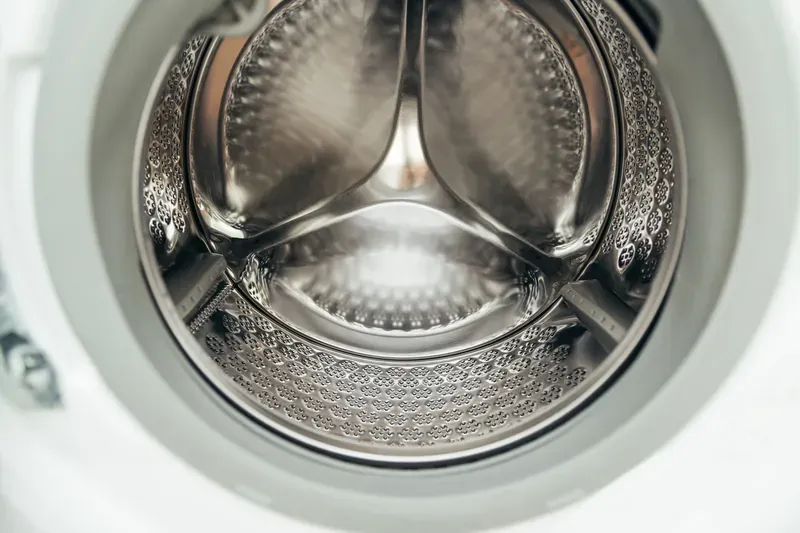 Photo: Vlad Deep via Pexels
So, before anything else: pick the fastest spin the garment permits, and send heavy loads, towels and bedding especially, through a second spin. A few minutes of electricity takes out water you would otherwise spend two days evaporating into a bedroom. The fabric sets the ceiling, and the care label is where that ceiling is written down. I went through those symbol by symbol in the laundry symbols piece. Knitwear and anything marked for a gentle cycle will not stand it. Cotton sheets, towels and jeans will.
Pick one room, shut the door, open the window
Council advice aims narrower than “ventilate the flat”. Ipswich puts it like this: “If you have to dry washing indoors, use the bathroom and keep the door shut and the room well ventilated.” Folkestone & Hythe words it its own way: “If you need to dry clothes indoors make sure the room is heated and ventilated” and “Keep a window open to allow moisture to escape”.
Three separate jobs are hiding inside that instruction, and they are worth pulling apart:
- One room. Water evaporates wherever the washing hangs. A room with an extractor fan and tiled, wipeable surfaces makes a far better host than a flat full of soft furnishings and cold outside walls.
- Door shut. This is the step people skip, and skipping it turns a contained problem into a whole-flat one. The hallway airer in a shared house is the standard example: everyone’s washing at once, every internal door standing open, five bedrooms downwind.
- Window open, or the fan on. The moisture still needs a way out of the building. A sealed bathroom with no ventilation is a damp box, and the ceiling will show you the proof inside a week.
Warmth speeds the evaporation up. Ventilation is the part that removes the water, and heat on its own only carries the problem as far as the first cold surface it finds.
Radiators, and why every source says no
Ipswich does not hedge: “Do not hang wet washing on radiators all around your home - doing so is very likely to cause condensation problems”. Folkestone & Hythe gives the same instruction. People write it off as fussiness. It is not.
A radiator dries clothes quickly, which sounds like an argument in its favour. Fast evaporation into a room with the door open is the worst possible version of this, though: the most water into the air in the least time, in a living room, on an evening when the outside walls have gone cold. Wet washing draped over the radiator blocks the heat as well, so the room warms less on the same gas, and a colder room condenses more. Stand the airer beside the radiator instead of on it, in a room with the door shut and the window cracked open.
A badly vented tumble dryer falls into the same trap. Folkestone & Hythe says to “Make sure your tumble dryer is vented properly”, and the reason deserves saying out loud. A vented dryer with its hose lying loose on the kitchen floor, or a condenser dryer whose tank nobody ever empties, lifts the water out of the clothes and hands it back to the room.
What I would not bother with
A dehumidifier is not where I would start. It is the priciest answer to a problem whose opening two steps, a harder spin and one room with the door shut, cost nothing at all. In a flat with nowhere ventilated to dry anything, where the damp keeps coming back, a dehumidifier in the drying room does earn its price. Third on the list, not first.
I would not reorganise the week around the washing either. Two loads dried in one room beat six small ones scattered about the flat to “spread it out”. The total water has not changed, and you have simply distributed it across more rooms. Wash less often, spin harder.
One more thing worth knowing if anyone in the flat has asthma or an allergy. Asthma + Lung UK is precise about bedding: “A 60°C wash will kill dust mites”. That runs hotter than most of us wash sheets, so check the care label allows it before you assume. The rest of the cleaning section covers the routine jobs this one sits alongside.