Search “first kitchen essentials” and you get the same list every time: a knife set, a dinnerware set for four, a drying rack, occasionally stretching past fifty items, none of it sourced anywhere. What none of these lists mention is the one fact that actually has a government statistic behind it: cooking causes roughly half of all accidental house fires. That seems worth knowing before I worry about a chopping board.
The checklist every search engine gives you
Type a first-kitchen checklist into a search engine and the results all read the same: pots and pans, a knife set, mixing bowls, storage containers, a dinnerware set, occasionally down to specific brands. None of it is wrong, exactly, and it is a reasonable list of things a kitchen accumulates over time. None of it is sourced, though. Nobody cites an authority for why a four-person dinnerware set beats a two-person one, because there isn’t one to cite. It is somebody’s opinion dressed up as a checklist: fine if you are furnishing a kitchen from nothing, useless if what you actually want to know is what matters first.
What actually has a number behind it
Two things about a first kitchen come with an actual figure attached, and neither one is equipment. The first is fire risk: the government’s Fire Kills campaign states plainly that cooking is “the leading cause of fires in the home, responsible for around half of all accidental dwelling fires.” The second is portion size. The British Nutrition Foundation’s own portion guide puts a single adult portion at 65g of dried rice, about two handfuls, and 75g of dried pasta, each working out to roughly 180g once cooked. One figure is a safety statistic. The other tells you how far a bag of rice actually goes. Both matter more while a kitchen is still empty than a knife set ever will.
Fire safety: the habit that matters before any equipment does
Half of accidental house fires starting in the kitchen is not a minor statistic, and the same Fire Kills guidance is specific about what to do about it, none of which costs a thing. Two habits are worth building in from day one: “keep tea towels, cloths and packaging away from the hob and oven”, and “check your cooker is off before going to bed or leaving your home”. Neither takes more than a few seconds, and both are habits rather than purchases, which is probably why neither shows up on a single gadget checklist. A pan left on a lit hob while someone answers the door, or a tea towel slung over a hot handle to dry off, accounts for more of that statistic than I would have guessed before reading the guidance. The same source explains why it happens: “fires can start when you’re distracted, when cooking is left unattended, or when flammable items are too close to the hob or oven or to a heater”. None of those three causes is an equipment problem. All three come down to what is actually happening in the room while something is on the heat, which makes this a habit worth building in the first week, not a product worth adding to a shopping list.
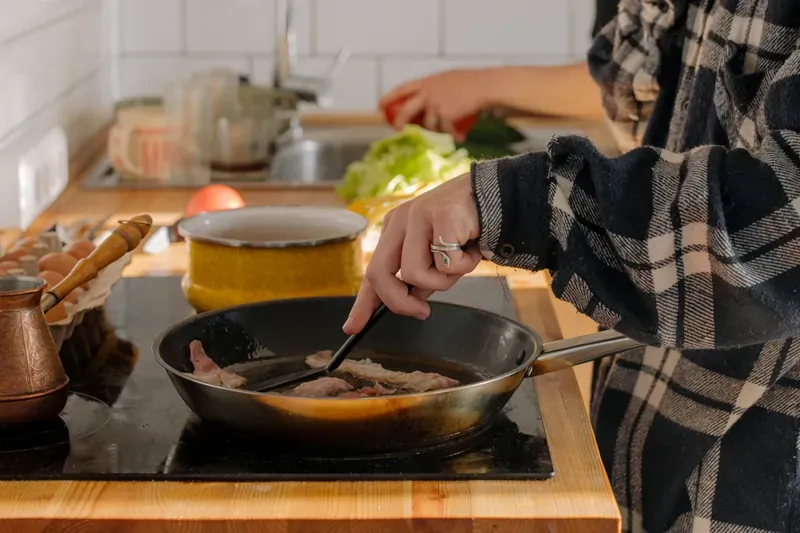 Photo: cottonbro studio via Pexels
Hygiene: it’s the cloths, not a chopping board set
The same pattern holds for hygiene. The gadget lists reach for colour-coded chopping board sets and specialist storage, and a commercial kitchen genuinely does rely on colour coding. A first flat does not need to copy a restaurant’s setup to get this right at home. The Food Standards Agency’s own guidance points to cloths instead: “use a separate cloth for surfaces and for washing up”, and “wash or change dish cloths, tea towels, sponges and oven gloves regularly”. A six-pack of cheap cloths covers this more thoroughly than a specialist board set costing ten times as much, and the weekly cleaning schedule already lays out the full weekly routine this habit fits into.
Pantry staples, worked out from a real portion size
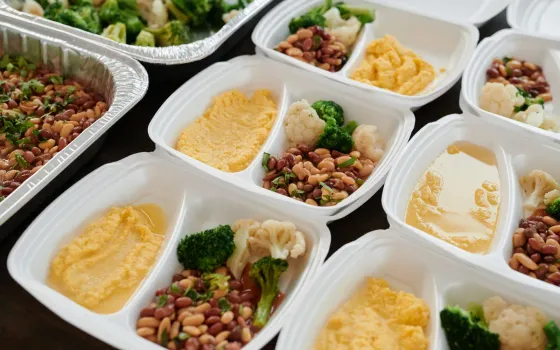
The 65g rice and 75g pasta figures are not just trivia. They turn a vague plan to buy some rice into actual arithmetic. A standard 1kg bag of rice works out to roughly fifteen 65g portions, so for one person eating rice twice a week, a single bag lasts close to two months before it needs replacing. For a household of three doing the same twice a week, the same bag is gone in closer to three weeks. The one-person meal planning piece covers the full version of this, including the trick of marking a mug at the 65g and 75g lines so nothing needs weighing out twice. Beyond rice and pasta, a first shop is reasonably built around a handful of staples with no precise sourced figure attached to them: tinned tomatoes, stock cubes, oil, onions and garlic, and a loaf that freezes well. None of those need a quantity worked out in advance. Buying a modest amount and topping up as it runs low works perfectly well there, which is more than I can say for guessing at rice and pasta.
What’s deliberately not on this list
This list leaves out a pot and pan count, a cutlery set size, and a dinnerware number, on purpose. Every gadget list online hands you a confident-sounding figure for all three, and none of them cites anything beyond personal preference, because there genuinely is no authority on how many saucepans a person needs. Buying those as you go makes more sense: replacing or adding to whatever turns up second-hand or gets lent by family, rather than shopping against a fixed checklist written for nobody’s actual kitchen. The two things worth getting right from day one are the ones with a real figure behind them: the habits that cut fire risk, and the portion maths that stops a first shop turning into waste.
Using the tool
Working out rice and pasta quantities by hand every time a household’s size changes is more arithmetic than it needs to be. The first-kitchen checklist takes a household size and hands back the fire-safety habits, the hygiene basics, and the portion-based staple quantities already worked out, rather than a guessed shopping list. Everything else that keeps a kitchen running once it is stocked lives in the meal planning section.