If the mattress has no protector, vacuum it once a week. Give it a bicarbonate-and-vacuum clean every three to six months, and air it every morning. Those intervals come from the NHS and a mattress manufacturer, and fitting a protector passes most of the weekly work over to the washing machine. A deep clean takes a morning rather than an afternoon, and the rule that outranks everything else is simple: nothing gets soaked.
What actually builds up in a mattress (and what does not)
Three things collect in a mattress. There is dead skin, there is sweat along with the moisture from your breath, and there are the dust mites that live off the first two. Mites are why cleaning intervals exist at all. They do you no harm directly. Their droppings are what set off allergies, and a mattress is the biggest, warmest and most humid piece of fabric in the flat.
Give it a few months and a mattress will have a smell, yellow patches where sweat has dried, and a mite population that the weekly sheet wash never reaches. You don’t need a specialist for any of it. A vacuum, fresh air and a protector cover the lot.
Humidity is the other lever, and I hadn’t thought about it until I read up on this. Allergy UK advises keeping indoor humidity “under 50% (but over 30%)”, because mites take their moisture from the air rather than from drinking. That is worth knowing in a small rented bedroom where nobody opens the window. A cheap hygrometer and ten minutes of open window a day will do more for the mattress than any spray sold for the job.
Weekly: the vacuum, or the protector instead
The dust-mite guidance from Cambridge University Hospitals NHS is not vague about this: “If you do not have mattress covers vacuum the mattress once a week”. So without a cover, it is a weekly job on the bare mattress, top and sides, using the upholstery tool. The easiest time is when the bed is already stripped for the sheet wash.
The alternative is a protector, and nothing else on this list saves as much work. A protector is simply a washable layer between you and the mattress. A barrier cover goes a step further: Allergy UK says it has to “completely enclose” the mattress, duvet and pillows, so the mites are sealed in or kept out. Fit either one and the mattress itself stays clean, which turns the weekly job into stripping the bed, washing the protector with the sheets and putting it back on.
That same NHS page says bedding not in allergy covers should be washed “on a 60º Cycle”, and Silentnight’s guide is blunter still: “Always use a mattress protector”. Before the first 60-degree wash, check the protector’s care label, since some have a polyester backing with a lower temperature limit (the symbols are decoded in how to read laundry care symbols). If you buy one whose label allows 60, the whole routine is easier. For anyone moving into a furnished room where the mattress comes with it, I would buy the protector first, ideally before the first night on it.
The NHS page also had a detail I had never seen anywhere: stay out of the bedroom “for at least half an hour after the bed is remade”, since stripping and remaking a bed sends dust into the air. So make the bed, shut the door and go and have breakfast.
Every three to six months: bicarbonate, vacuum, air
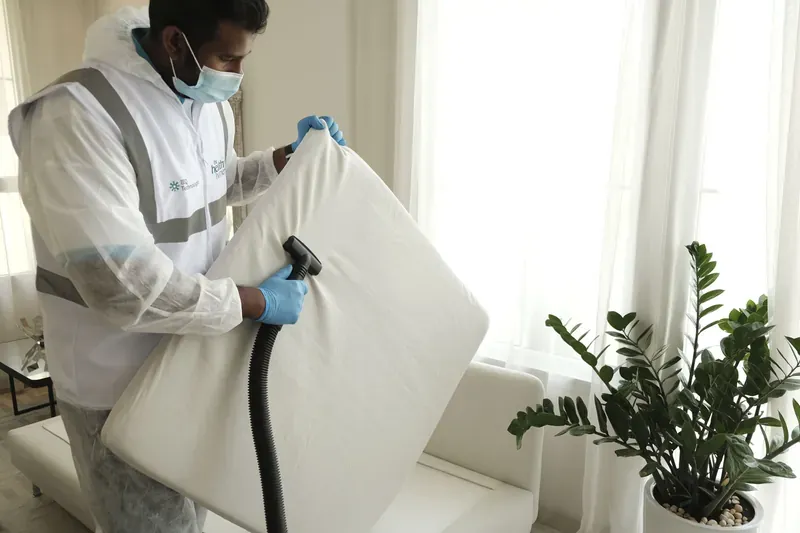 Photo: thehealthyhome.me via Pexels
Silentnight’s position is “We always recommend that you clean your mattress every 3 to 6 months”, by which it means a general vacuum and spot clean. Anything heavier, which for Silentnight means steam cleaning, it says you need no more than twice a year. If you start a quarterly clean on a Saturday morning, the mattress should be dry and made up by bedtime. The actual work is about half an hour; the rest is a few hours of leaving it alone.
- Strip the bed, put the protector and sheets in the wash, and open the window.
- Work over the top and sides with the upholstery tool, slowly, in overlapping strips. Spend longer on the seams and the piping round the edge, because that is where dust gathers.
- Sprinkle bicarbonate of soda across the surface. A thin, even layer is enough; this is not icing a cake. The manufacturer’s guide says to “leave it to sit for at least 15-30 minutes, or longer if needed”. My reading of “longer” is an hour, which is time enough to clean the rest of the bedroom.
- Vacuum it all up, slowly again. The bicarbonate takes the odour with it, and this second pass picks up whatever the first one loosened.
- Leave the bare mattress to air with the window open for as long as you can manage, ideally the rest of the day. If it is double-sided, turn it now (the rotating section below explains how).
- Once the protector has been washed and dried, put it back on.
Bicarbonate has two uses here. It absorbs smells, and it forces you to run the vacuum over every inch a second time. It does not sanitise anything. The vacuum and the airing are what do the real work.
Stains: dab, mild soap, no soaking, and why the foam must dry
Stains are where most mattress damage happens, usually because someone pours on cleaner and water and soaks the foam underneath. Dab, never pour.
Mix a little washing-up liquid or mild soap into a bowl of cold water. Dip a clean cloth in and wring it out until it is only just damp. Dab the stain from the outside inwards, then rinse the cloth in clean water, wring it out again and dab once more to lift the soap out. Finish by blotting with a dry towel. If the stain is still there, go through the process again instead of reaching for more water.
After that, you wait. Silentnight’s guide says to “Allow the mattress to air dry completely before putting your bedding back on. This may take several hours”. The foam and padding inside hold on to moisture, and a damp patch under a sheet with a warm body on top is exactly what mites and mildew want. If you have a fan, point it at the patch. In a room that gets no sun, several hours can easily become a whole day, which is another reason to start in the morning.
Steam cleaners, carpet shampooers and anything else that drives water into the mattress should stay well away from it, and bleach and other strong products should stay in the cupboard. Silentnight’s guarantee booklet warns that detergents or chemical cleaners used on the mattress can damage its fabric and stitching, and on top of that they leave a residue you end up sleeping on.
Rotating and airing: the two-minute habits
Over the life of a mattress, two small habits from the manufacturer’s care booklet do more good than the quarterly clean does.
One is airing. Silentnight’s guarantee booklet says to “Air your mattress daily by pulling back the bed covers”. All that means in practice is not making the bed the moment you get up. Pull the duvet back, open the window, get dressed and have breakfast, and make the bed afterwards. Twenty minutes of the mattress sitting bare each morning lets the night’s moisture out before the duvet traps it in. With a partner in the bed, there is twice the moisture to clear, so the habit matters more.
The other is turning. The same booklet says a double-sided mattress should be turned and rotated “top-to-toe” regularly, and a single-sided one rotated “top-to-toe” as well. With a new double-sided mattress, it asks for this once a week for the first two or three months, then monthly. Rotating spreads the wear so the dip where you sleep doesn’t become permanent. Most modern mattresses are single-sided and only need rotating; if you aren’t sure which kind yours is, the booklet says to check the label underneath. The quarterly clean is the obvious moment, since the mattress is bare anyway. Lifting one is a two-person job, so if you live alone, I would save this for when someone comes round.
The booklet has something on slatted bed bases too: each slat should be at least 10cm wide, with gaps between them of no “more than 7.5cm”. Wider gaps let the mattress sag through and wear out faster, so a cheap rented bed frame is worth checking with a tape measure. A sofa bed mattress that gets folded away every day needs the same care, especially the rotating and airing, and the guide to choosing a sofa bed covers what to look for in one.
When cleaning stops being worth it and replacement is
Eventually no amount of bicarbonate will help, and it is better to admit that than to spend more Saturday mornings on a mattress that is finished.
The signs are structural, and you can feel them. There is a dip that stays put after rotating. There are springs you can feel through the padding. A smell comes back within a week of a full clean and airing. Your back is stiff in the morning and eases once you have been up for a while. Any one of those means the structure has given out, and cleaning the surface of a collapsed core just gets you a clean surface to sleep badly on.
Cleaning is worth the effort on a mattress that is structurally sound but smells stale, has marks on the surface, or has simply never been cleaned. A quarterly clean, a protector and airing it daily will keep a good mattress pleasant for as long as the springs or foam last. If the mattress is the landlord’s, a protector is also the cheapest insurance you can get against losing part of your deposit, so buy that before any cleaning product. Routines for the rest of the bedroom and the bathroom are in the cleaning section.