The spec sheet of a sofa bed worth sleeping on lists two numbers, mattress depth and mattress width, and both tell you more than the photos do. A “double” with a 12cm mattress is a guest bed: fine for two nights. Push the foam to 20cm-plus and someone could sleep on it for a fortnight. Buying second-hand adds a third check, the fire label, and that one decides whether you buy it at all.
On any listing, I’d read the mattress line before the fabric line. It tells you more, and retailers usually tuck it away in the specification tab.
Who is sleeping on it, and how often
The answer sets both the budget and the kind of mechanism, so work it out before opening a single listing.
Someone who visits twice a year will put up with nearly anything for two nights. Buy the sofa you actually want to sit on and count the bed as a bonus. A thin pull-out mattress, plus a topper kept in the wardrobe, does the job.
A guest who stays a week, or a partner’s parent who comes every month, needs a proper mattress. Proper means deep, and depth is exactly what makes sofa beds heavy and expensive.
Sleeping on it every night, in a studio or in a flatshare where the bedroom doubles as the living room, means you are buying a bed that happens to fold, and the sofa is the afterthought. The mechanism has to cope with being worked twice a day for years, and the mattress has to be one you’d accept on a normal bed. This is where I would spend the most, and where I’d search the second-hand market hardest for something that was expensive new.
Mattress depth: 12cm and 23.5cm are different products
Two listings from the same retailer show the spread. This velvet three-seater at Dunelm, a fairly ordinary “double” sofa bed, gives its mattress as 182cm long, 132cm wide and 12cm deep, folded into a sofa 179cm wide and 91cm deep. Dunelm’s click-clack “large double” lists a foam mattress 215cm long, 112.5cm wide and 23.5cm deep.
Twelve centimetres is thin enough that the frame makes itself known by the second night. It has to be that thin to fold up inside the seat. Twenty-three and a half is a real foam mattress, and the click-clack gets away with that thickness because nothing folds: the seat and back cushion simply lie flat and become the mattress. I hadn’t realised how much each mechanism limits the mattress until I had the two spec sheets open next to each other.
So check the depth first. Under 15cm is a guest bed. Over 20cm, it could take regular use. Anything in between, plan on a topper and keep your hopes modest.
Bed width: measure the mattress, not the sofa
A sofa bed sold as a “double” isn’t necessarily 135cm, which is what a standard UK double mattress measures. Go back to the two examples. The 12cm mattress is 132cm wide, close enough to a proper double. The deep click-clack, marketed as a “large double”, is 112.5cm, nearer a small double, because the arms eat the rest of the width.
That 20cm is the gap between two adults sleeping and two adults lying very still. At 112.5cm one person has room to spare. Two people have a compromise, and it is better to know that before the van turns up.
Length matters as well. A tall guest on the 182cm mattress will have feet hanging off the end; the 215cm one leaves space over.
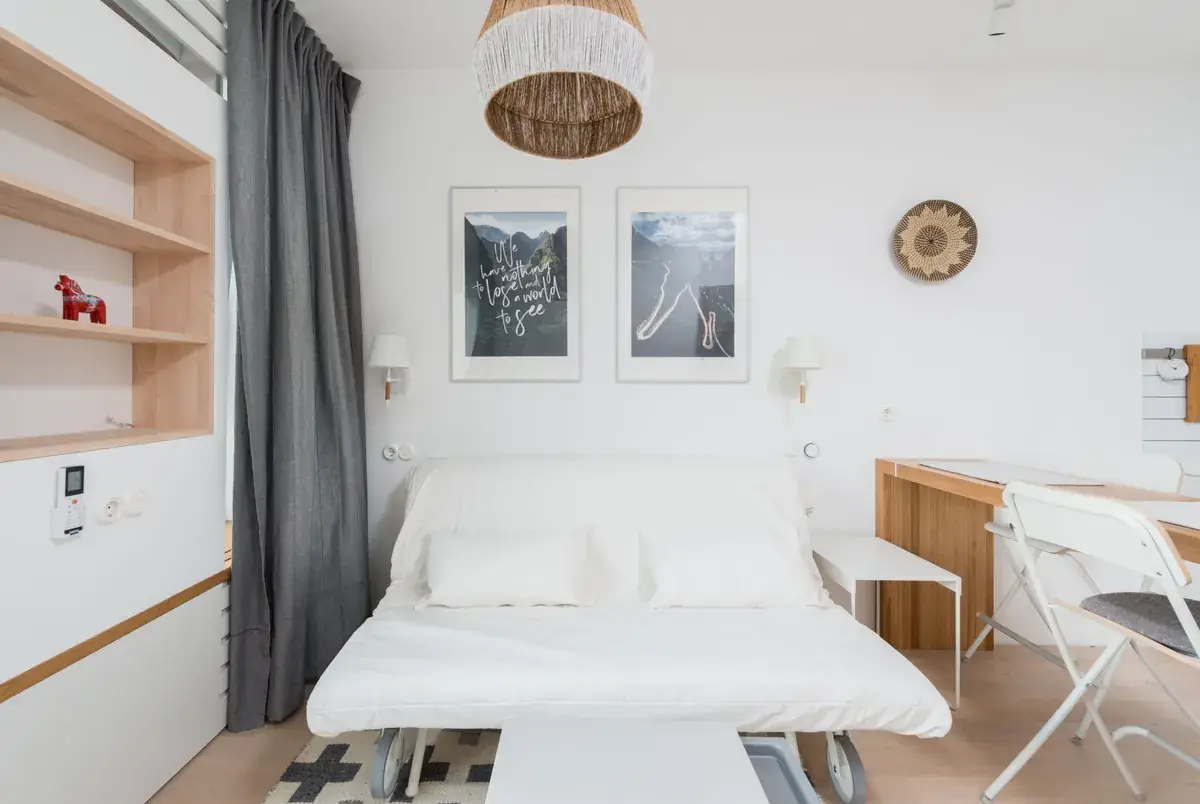
Listings put the sofa’s overall width in large print and leave the mattress dimensions in the specification tab. Sofa width tells you if it fits against the wall. Mattress width tells you if it fits the people sleeping on it. The product photo only shows you the first.
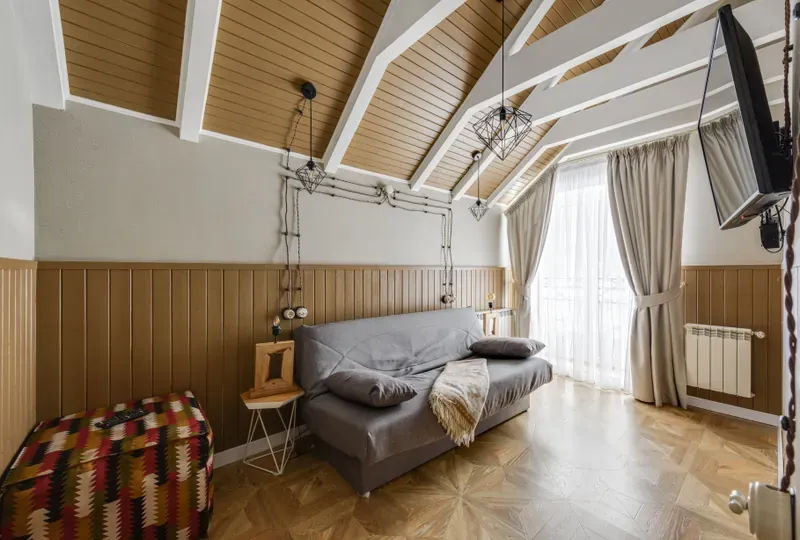 Photo: Max Vakhtbovych via Pexels
Mechanism: click-clack versus pull-out, and the floor each needs
A click-clack turns into a bed when you fold the back down flat, so the whole sofa is the bed. The bed is the same length as the sofa, and because the back drops down you need about 90cm of clear floor behind it, or you have to pull the sofa that far from the wall. What you get is speed, no separate mattress to store, and usually the deeper mattress of the two types. What you give up is comfort sitting down: they tend to be firm and upright.
A pull-out keeps a folded metal frame and a thin mattress under the seat cushions. The bed unfolds forwards, so you need roughly its length clear in front, about 190cm, and space to stand beside it. The sofa is better, since the seat cushions are real sofa cushions, and the bed is worse, since the mattress has to fold. It is heavier too, and on used ones the frame is what breaks.
Before you buy, mark out the open bed on the floor with masking tape and leave it there for a day. In the living room of a one-bed flat, an open pull-out can take over the coffee table, the television stand and the route to the kitchen. No one bothers making up a bed if two other bits of furniture have to move first, and I’d apply that same test to all furniture in a small flat.
Both kinds of mattress pick up the same sweat and dust as any other, and they air out worse because they spend most of their time folded shut. Treat it like the mattress on the bed in the bedroom; there is a separate piece on how often cleaning it is actually worth doing.
Second-hand: where the fire label is and when to walk away
Good sofa beds are expensive new and cheap used, mostly because they are heavy and a pain to move. So the second-hand market is the sensible place to look for a click-clack with a deep mattress, as long as you do the one check that can’t be skipped.
In the UK, upholstered furniture has to carry a permanent fire label. Trading Standards’ guidance on second-hand upholstered furniture says the label “is usually found behind a loose cover at the rear of the furniture or under a seat cushion”, and that it has a batch code linking it back to the manufacturer. It also says labels that are stapled on need “further checks”, because they “may have been added at any time”. Before reading that, I’d assumed the label was just something shops did, not the law.
Standing in the seller’s living room, that means lifting the seat cushion or unzipping the back and finding the sewn-in label. One stitched into a seam is fine. A stapled swing tag, or nothing at all, and you leave.
While you’re there, open and shut the mechanism twice, sit on the open bed both in the middle and at the edge, and check the frame for sag. Then measure the mattress, not the sofa.
Fitting it through the door and up the stairs
A sofa bed is heavier than an ordinary sofa and barely comes apart. The frame is steel. A pull-out double is a two-person carry, and it won’t make a tight turn on the stairs unless it can go up on end.
Measure the clear width of the front door, the narrowest part of the stairs and any turn at the landing. Check those against the sofa’s height and depth, not its width, since it will go through on its end or its side. Ninety centimetres deep is the measurement that gets sofa beds stuck on the stairs of converted houses. If the listing doesn’t give packed dimensions, ask the seller.
This is where a second-hand bargain tends to come undone: the seller’s building had a lift, and yours has a half-landing. Measure before any money changes hands.
Read the mattress line, tape the open bed out on the floor, and find the label. The rest of the small-spaces articles start from the same habit of measuring before paying.