In a small flat, a piece of furniture earns its floor space by passing four checks. Every route stays at least as wide as a new-build doorway, it does two jobs without one getting in the way of the other, its folded size has been measured against a particular wall, and you actually fold it. Fail one and you have paid for a clever object that stands in front of a door. The full test is five questions, each with a number attached, and all it needs is a tape measure and about ten minutes.
Mostly I built it to catch one thing: the coffee table that lifts to desk height and then leaves nowhere to walk past it, which is exactly the trap finding somewhere for a desk in a one-bedroom flat tends to fall into.
Question one: does it leave the route clear?
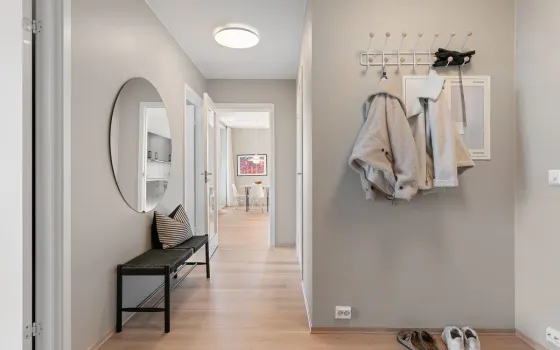
Do the measuring before you open a single listing. Open every door in the flat and measure the clear opening. Measure each corridor wall to wall. Then walk from the front door to the bedroom, the bathroom and the kitchen, and note the narrowest point on the way.
For a benchmark, I would borrow the widths new homes have to meet. Approved Document M for dwellings sets out, in Table 1.1, a doorway clear opening of “750 or wider” against a corridor of “900 (when approached head on)”. Then it adds: “A standard 826mm door leaf up to 44mm thick will be deemed to satisfy a requirement for a clear opening width of 775mm”. Those are minimums for new builds. A converted flat might already fall short of them, and if so, your own measurement is the number to work to. I did not expect building regulations to be any use when buying a table. They are, though, because they hand you a figure nobody can argue with.
So the rule is simple. Nothing new gets to squeeze a route below 750mm at a doorway or 900mm along a corridor in its normal in-use position. In use means open, not folded away. A sofa bed is judged with the bed pulled out; a drop-leaf table with the leaf up and the chairs out. Pass folded and fail open, and it fails.
This first question knocks out most transforming furniture.
Question two: does it do two jobs, and does the second one cost the first?
A bed can get away with doing one job, and so can a sofa. Almost everything else in a small flat should earn a second: a bench with a lid, a table that seats two and then four, an ottoman that holds your feet on top and blankets underneath.
The trap is when the second job cancels the first. A storage bench you have to clear of coats and bags before you can open it is just a bench. A lift-top coffee table that has to be emptied of mugs before you reach the storage is a coffee table, nothing more. Good pieces keep the two jobs separate. The bench holds what you need once a week (spare bedding, the iron) and spends the other six days as a seat. The drop-leaf table keeps placemats and cutlery in its drawers, which you only want when the leaf is up anyway.
Ask two things of each job: how often will I do this, and what do I have to move first? If the answer to the second is “everything that’s on it”, one of those jobs is really decoration.
Question three: what is its folded size, and where does it live folded?
Listings print the open size. What matters in a small flat is the folded size, and exactly where that folded shape is going to stand. That means a particular wall you have measured, not “somewhere”.
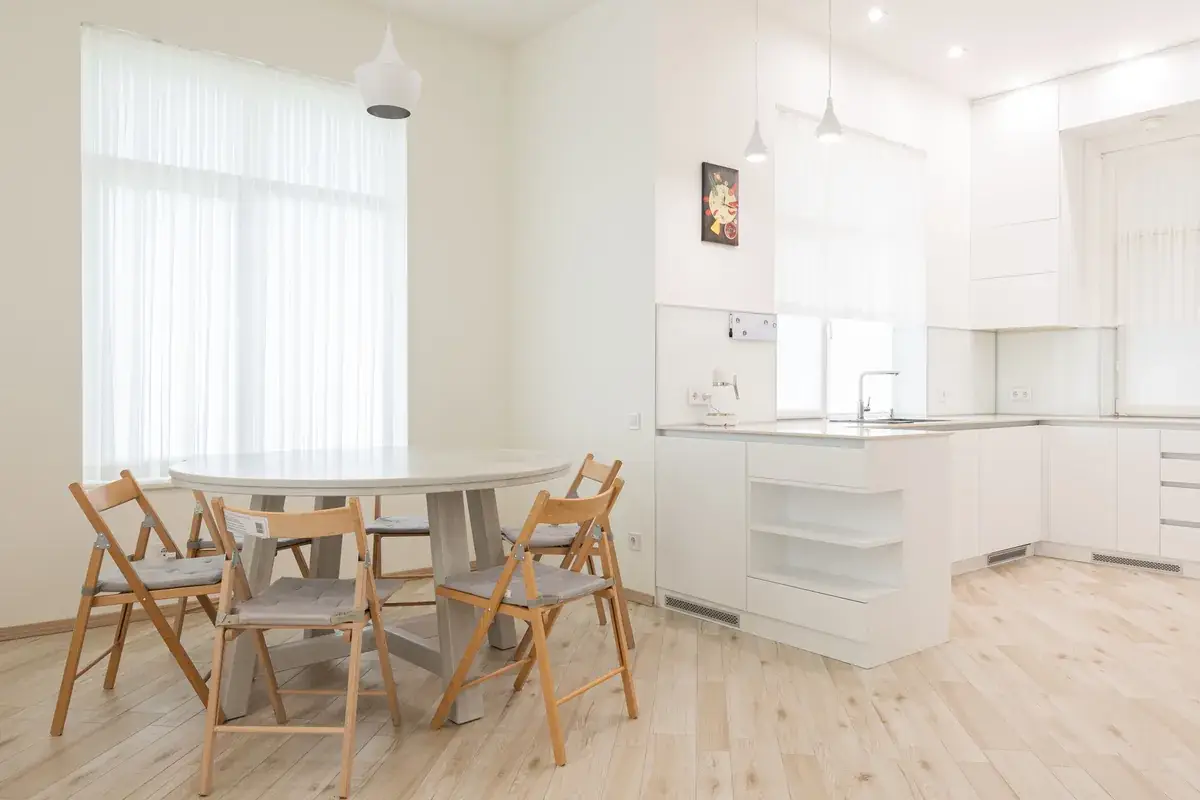
Of everything I looked at, the drop-leaf table gets through this question most cleanly. This one at Dunelm is a typical two-to-four seater drop-leaf from a high-street retailer: 41cm wide folded and 152cm wide extended, 90cm deep and 78cm high, with storage drawers. At forty-one centimetres it can sit against the hallway wall or behind the sofa as a console table. At one hundred and fifty-two it seats four for dinner. The folded size gets checked against the wall; the open size gets checked against question one.
When a listing leaves out the folded size, ask the seller for it. And if there is no free wall in the flat 41cm deep and 152cm long, the table does not fit, however neatly it folds.
 Photo: Curtis Adams via Pexels
Question four: will you actually fold it?
Anything with leaves or lids only earns its space if it gets put back every day. A drop-leaf left up is a dining table that wobbles slightly at the edges. A sofa bed left out is a bed with arms.
My test is whether folding it fits into a fifteen-minute evening reset without making it longer. Folding a table leaf takes fifteen seconds, which is less time than the kettle takes to boil. Closing a sofa bed means stripping the bedding, putting it away and lifting the frame back. Call it three minutes, and that is exactly the size of job people skip. In the living room of a one-bed, a sofa bed turns into a bed only when guests stay, so buy it as a sofa first.
If you already know you won’t fold something, get the fixed version instead. It is cheaper and sturdier; just size it for question one in its open state. There is no shame in that, and for most people it is the honest answer.
Question five: can you get it out again?
Small-flat furniture moves more often than most, because tenancies end. The last question is whether the piece will go back out through the door, down the stairs and into a van without anyone needing a saw.
Flatshares end as well, and it is the big pieces that cause trouble when they do. People leaving shared houses describe the same thing over and over: on paper the sofa bed belongs to nobody, and in practice it belongs to whoever can’t get it down the stairs. Keep shared pieces cheap and light, and write down who owns what.
Flat-pack furniture can usually go back to being flat-pack, as long as you kept the fittings. A welded steel frame cannot. Before buying, measure the piece on its side or on its end against the tightest turn of the stairs. Heavy, deep, awkward pieces that came up in a lift and now have to go down past a half-landing are the reason so many good sofa beds sell cheaply second-hand.
Three pieces scored
First, the drop-leaf table from earlier. Route clear: yes when folded, and when open only if the chairs push in underneath, since the 90cm depth needs a room where the table is not on the way to the kitchen. Two jobs: dining table and console, plus the drawers, and neither job empties the other. Folded size: 41cm, measured against the hall wall. Will it get folded: yes, every day. Out again: flat-pack and light. Pass.
Second, a storage bench. This one at Dunelm is a typical upholstered ottoman bench of the sort high-street retailers sell: 39cm high, 104cm wide and 39cm deep, with an 87.4 litre storage compartment listed and a seat that is “Tested to 110kg”. Route clear: at 39cm deep, yes at the end of a bed or in a hallway over 130cm wide, and no in an 80cm hallway. Two jobs: a seat plus 87.4 litres, which is enough for roughly one duvet and two pillows, or a winter’s worth of hats and scarves. You sit on it every morning to put your shoes on and open the lid once a week. Folded size: it doesn’t fold, so it just stays where it is. Will it get folded: not applicable, though the lid stays shut because it is being used as a seat. Out again: one person can carry it. Pass, in the right hallway.
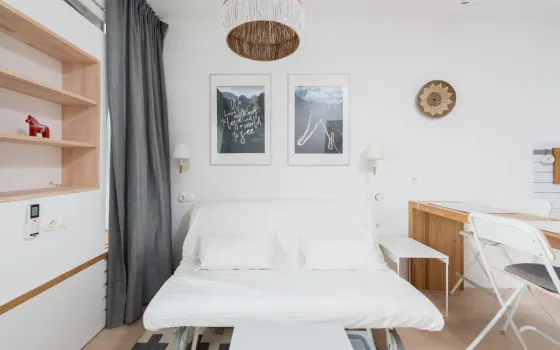
Third, a sofa bed. Route clear: open, almost never in a one-bed living room, because 190cm of bed ends up on the coffee table and across the route to the kitchen. Two jobs: sofa and bed, and the bed wipes out the sofa completely. Folded size: the size of the sofa. Will it get folded: only for guests. Out again: heavy, steel, and often impossible without a lift. It passes only if you accept it as a sofa with a bed for two nights a year, which is the case I make in the piece on choosing a sofa bed. As an everyday bed for anyone in a flat with a narrow living room, it fails.
What matters is getting the measuring done before the van turns up. Most of the other small-spaces articles take a single piece and put it through these same five questions.