Adhesive hooks will take up to about 3kg on a rented wall and leave no holes behind. A shelf needs a proper plasterboard fixing, and an email to the landlord before it goes up. Anything heavier, in a flat that isn’t yours, belongs on a freestanding unit or a tension pole. What decides it is the weight of the thing, not which room it’s in.
Coats, a bike, pans, shelves: every one of them comes down to the same three questions. How heavy is it, what is the wall made of, and has the landlord said yes in writing? I assumed there would be more to it. There isn’t.
Find out what your walls are made of
Start by knocking on the wall with a knuckle. If it sounds dull and solid, you have brick or block under the plaster. If it sounds hollow, with a slight echo, it’s plasterboard on a timber or metal frame, or dot-and-dab board stuck onto blockwork. Newer flats and the partition walls in conversions tend to be plasterboard. The outside walls of older buildings tend to be solid.
This matters because each type wants a different fixing, and each reacts differently to an adhesive hook. Strips hold best on smooth painted plasterboard. They hold worst on wallpaper, textured paint or anything dusty, and when they give up on those surfaces, the usual result is a hook still stuck firmly to a strip of wallpaper that is no longer on the wall.
It’s also worth asking when the walls were last painted. New paint needs a few weeks before any adhesive goes near it, or the strip takes the paint with it when it comes off.
Under 3kg: adhesive hooks and where they stick
This covers most of what people actually want to hang up: a coat, a bag, a tea towel, a dressing gown, a hand towel, a small mirror, a string of lights.
Go by the rating on the maker’s website, not the claim on the packet. tesa lists its Powerstrips XL Utility hooks as “Holds up to 3 kg per hook”, on smooth and solid surfaces, and says they come off “without leaving a trace”. That only holds if you follow the instructions and pull the tab straight down, flat along the wall, rather than out towards you. Pull it outwards and the strip snaps while the hook stays exactly where it was. I didn’t know there was a wrong way to pull a tab until I read the page.
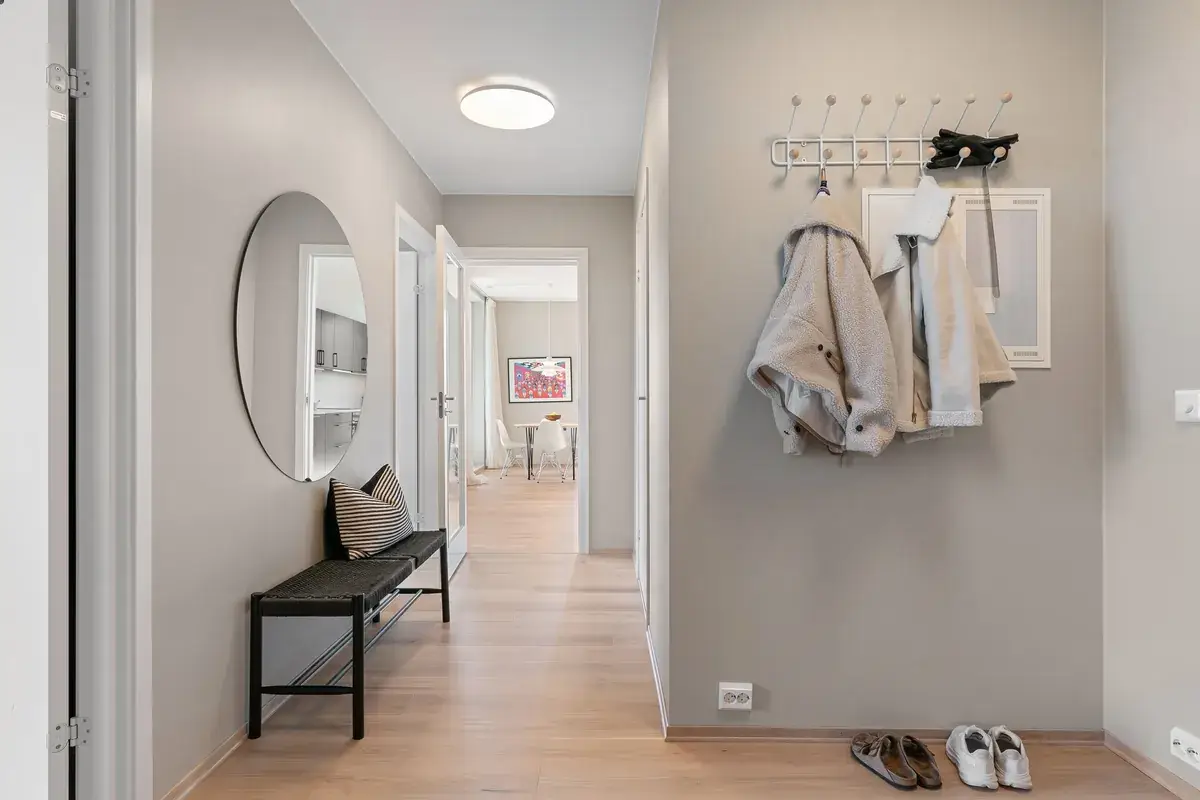
For a sense of scale, 3kg is a winter coat with keys in the pocket and a bag hung over it. It is not a shelf, however small, because a shelf levers against the hook at an angle the rating never accounts for. Put the hooks about 10cm apart and give each one a single item. Five in a row at 3kg each will take a whole household’s coats, which on its own can sort out the hallway you all share without a single screw.
“Smooth and solid”, in practice, means tiles, gloss paint, laminate cupboard sides, the insides of doors and the metal front of a fridge. It does not mean wallpaper of any sort, textured emulsion or bare plaster. The one that catches people out most is cheap wipeable emulsion. The hook holds fine, then pulls off a patch of paint when you remove it, and that is worse than a screw hole because there is nothing to fill.
In a shared house the hallway belongs to nobody, everybody walks through it, and the coats end up in a heap on the floor. The cheapest fix I can find is one adhesive hook each, 3kg per hook. It is hard to argue with a rule that simple.
The textbook mistake is a hook on the wallpapered wall next to the front door. It holds for months, then rips a corner of paper away when it finally lets go. According to the deposit scheme, that is exactly the sort of mark landlords claim for, and it is entirely avoidable.
Over 3kg: the email and the fixing
Past 3kg you are drilling, whether it’s a shelf, a bike, a pan rail, a television bracket or a heavy mirror. On plasterboard the fixing decides how much the wall will hold. The landlord decides whether the hole gets made at all.
So the email goes first. In a flatshare, whoever is named on the tenancy sends it and everyone keeps a copy, since the deposit belongs to all of you. Say what you want to put up, roughly where, how many holes it needs, and that you’ll take the fixings out and fill the holes when you leave. The deposit scheme gives the same advice (more on that below), and the written yes is what you show at check-out.
Then choose the fixing. The self-drill plastic plugs that come boxed with a shelf are meant for pictures. For plasterboard that has to hold real weight, use the wing type. The Gripit Red is rated “holds up to 74kg”, needs an 18mm hole and comes with a 5.0 x 30mm screw. Keep that 18mm in mind. It is a large hole, and it is the reason you ask first. What makes it good for renters is that the wings fold back, so the whole fixing pulls out of the wall and you fill a hole rather than digging out a plug.
Two fixings rated like that behind a shelf bracket will hold anything you would sensibly put on a shelf in a flat, and the bracket will go before the wall does. That still doesn’t make 74kg a licence to hang a bike from one point. Every time the bike goes on or comes off, the load on the hook jolts, so use two fixings and a wall-mounted bike hook rated for the job.
Solid brick is simpler. A masonry bit to drill the hole, a wall plug and a screw. The permission email is the same.
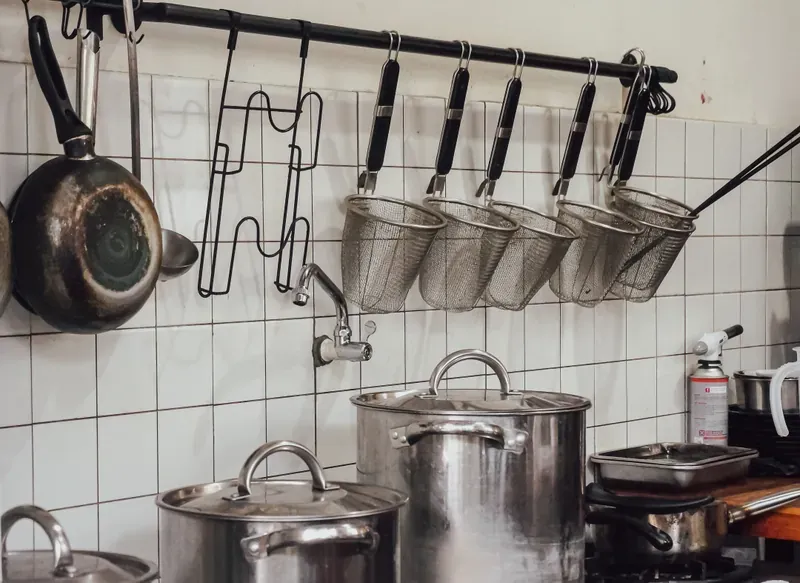 Photo: Firman Marek_Brew via Pexels
Zero-hole options: tall units and tension poles
When the landlord says no, or the wall is papered, go freestanding. Two things cover most of it.
One is a tall, narrow bookcase or shelving unit, 30 to 40cm deep and as tall as the ceiling lets you go. It holds about as much as three wall shelves on roughly the floor space of a doormat. In a kitchen it takes the pans, the oil, the bread and the recipe books you might otherwise have hung from a rail. That idea runs through the piece on sorting a small kitchen without buying anything new, since plenty of flats already have one of these units sitting in the wrong room. Heavy things go at the bottom, and if children live in the flat, fit a strap or an anti-tip bracket. The bracket needs one small screw, and a landlord reads a request for one small screw very differently from a request for an 18mm hole.
The other is a tension pole, the spring-loaded sort wedged between floor and ceiling, which carries hooks and small shelves without touching the wall at all. Check the rating on the pole, and put a rubber foot under the top if the ceiling is plasterboard, or it will leave a dent. I would not trust one with a bike. It is made for coats, a bag and a couple of baskets.
Over-door hooks and the backs of cupboard doors make up the rest of the free vertical space in a flat, and neither leaves a mark.
What the deposit scheme actually deducts for
A Tenancy Deposit Scheme blog post on landlords’ claims is clearer than most tenancy agreements. It says landlords do claim for “damage to walls, ceilings and furniture caused by blu-tack marks, sticky tape or holes where nails, hooks or drawing pins have been used”. It also admits that deciding whether a mark is wear and tear “can be subjective”. Its advice matches the email above: “contact your landlord or letting agent in advance of making any changes to the property”.
In other words, any mark could become a claim. The way to stop that is to agree things in advance and give the wall back the way you found it. I was surprised to see drawing pins on the list. I’d assumed they were too small to bother anyone.
Everything you need at check-out fits in a shoebox: a small tub of ready-mixed filler, a filling knife, fine sandpaper and a tester pot in the wall colour. Get the tester pot at the start of the tenancy, while the letting agent can still tell you what the colour is. Filling a screw hole, sanding it flat and touching up the paint takes five minutes a hole. What the box can’t do is mend a patch of wallpaper that has lifted.
A wall-by-wall plan for a one-bed
Hallway: a row of adhesive hooks on the painted wall, 3kg each, one item per hook. Shoes on a low rack, off the floor.
Kitchen: a tall freestanding unit for pans and dry goods, plus a short adhesive rail on the tiles for utensils, because tiles are where the strips grip best. Leave the splashback alone rather than screwing a pan rail into it.
Bathroom: adhesive hooks on the tiles for towels and the dressing gown, and an over-door hook for the second towel.
Living room: one proper shelf on two plasterboard fixings, after one email, holes filled when you move out. The bookcase handles everything else.
Bedroom: keep the walls bare. Under-bed boxes and the wardrobe carry the load.
Bike: a wall hook in the hallway on two rated fixings if the landlord agrees, a floor stand if not.
Add it up and it comes to one email, two holes and a shoebox of filler. The rest of the small-spaces articles work on the assumption that the walls stay clean.