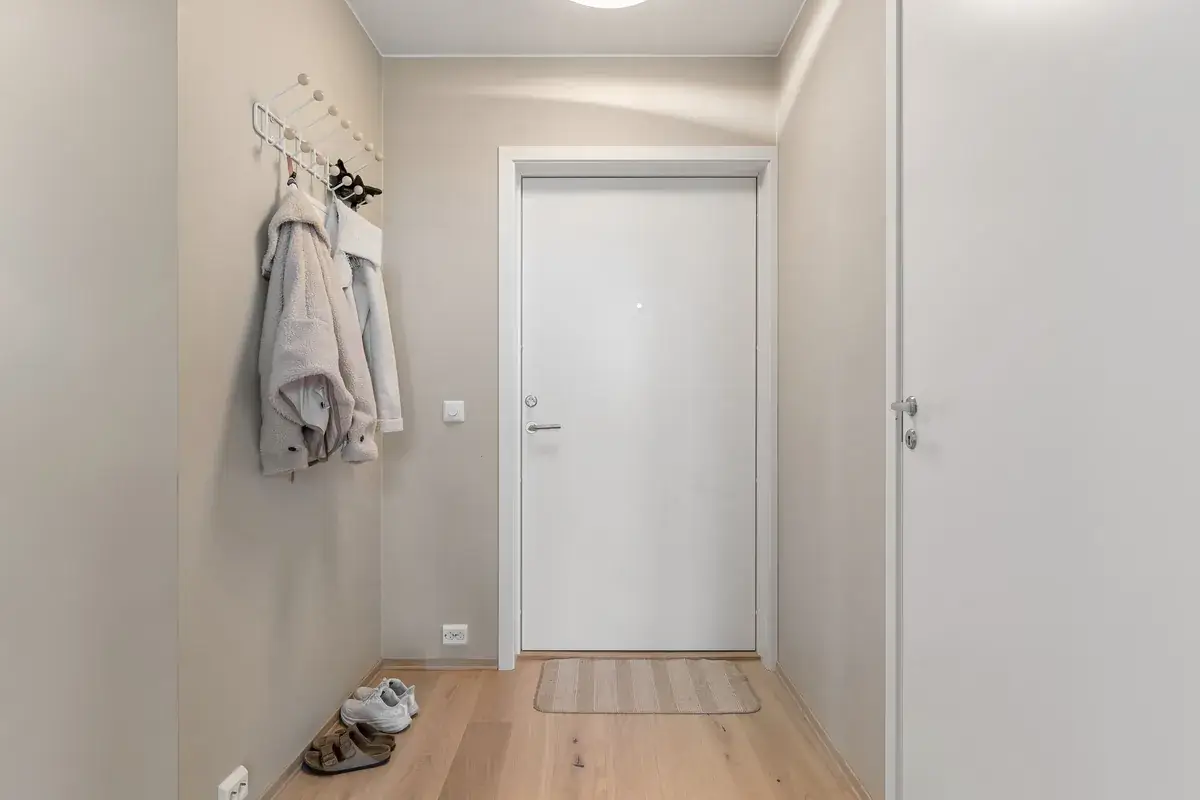
A narrow flat hallway has room for one hook and one pair of shoes per person by the door. Not much more. The bulky things (the bike, the pushchair, the recycling) belong somewhere else in the flat or in a proper store. Fire guidance says the shared corridor outside your door has to stay clear, and the hallway inside it is how you get out. The test I’d use needs a tape measure: once the shoes and hooks are in place, aim for roughly 900mm of clear width, and never let it drop below 750mm at any point.
This is written for the usual set-up. The hallway is about a metre wide and a few metres long, you share it with a partner or flatmates, and the front door opens onto a landing in a block. Living alone doesn’t change the rules; it just means the only person you have to negotiate with is you. I’ve put the reason beside each rule, because I wanted the reasons myself before I believed any of them.
Two hallways: the one inside your door and the one outside it
Most flats really have two hallways, and they run on different rules.
The one inside your front door is yours. You can put more or less what you like there, and the limits are practical ones: you have to be able to get out fast in the dark, and two people have to be able to squeeze past each other. The one outside is another matter. The communal corridor, landing or stairwell belongs to the building, however close it is to your door, and fire safety decides what goes there. You don’t get a vote.
What the fire guidance says about the corridor and the front door
The London Fire Brigade doesn’t soften it. Its guidance for purpose-built flats says communal corridors and staircases must be kept free from clutter, including pushchairs, e-bikes, mobility/e-scooters or rubbish. The same page says your front door, and any doors on hallways or landings, should be maintained as self-closing fire doors and must not be left propped open, because this allows toxic smoke and fire to spread quickly.
The government’s guide for small blocks comes at it from the building’s side and lands in the same spot. Modern fire doors have a fire resistance of at least 30 minutes, and new flat entrance doors opening onto common parts should be FD30S doors. On storage, the guide says the common parts should be kept clear of any combustible materials or storage. It recommends a zero-tolerance approach, where residents are not permitted to use the common parts to store any belongings or dispose of rubbish, and says storage of mobility scooters and similar powered mobility aids, such as e-scooters and e-bikes, should generally be prohibited. That is stricter than I expected.
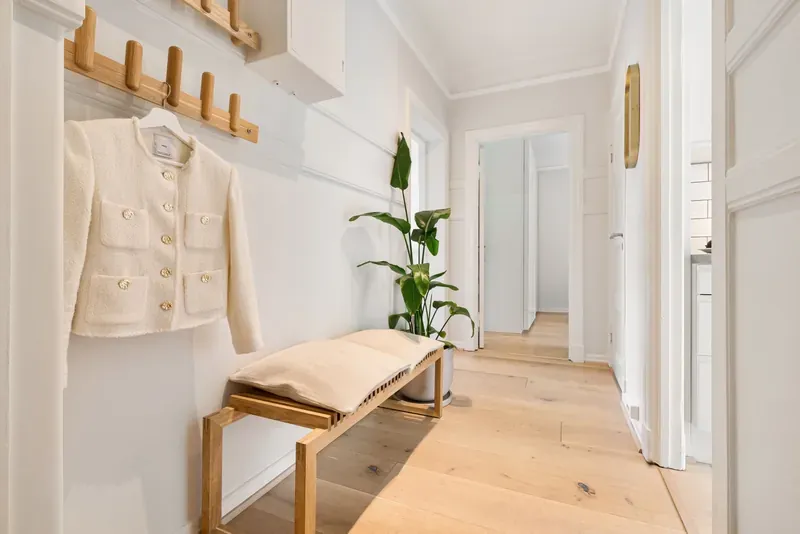 Photo: Lisa Anna via Pexels
In practice, I take three things from that for a flat. One: nothing of yours goes on the landing, recycling included, not even for an hour. Two: the front door closes on its own every time. If the closer has been disconnected or the door won’t latch, that’s a repair for the landlord or managing agent, not a job for you and a screwdriver. Three: you don’t wedge the door open to bring the shopping in. You make two trips.
The tape-measure test: 900mm, and never under 750mm
I wanted an actual number for how much clear floor to leave in your own hallway, and the nearest I could find is in the building regulations guidance on access in new homes. For its Category 2 dwellings, Approved Document M says the minimum clear width of every hall or landing is 900mm. Even in basic Category 1 dwellings, it only allows a localised obstruction such as a radiator if the corridor is not reduced below a minimum 750mm width at any point.
Those figures are about how new homes get built. They don’t say anything about what a tenant can keep in a hallway, so I use them as a test rather than a rule. Put the hooks up and the shoes down, then measure the hallway where it’s narrowest. Around 900mm is what the designers had in mind. If a shoe rack, a bag or a bike takes the clear width under 750mm anywhere along the way, two people can’t get past each other and nobody gets out quickly in the dark. That item goes.
The numbers make more sense with an example. Picture a hallway 1,000mm wide, where a radiator narrows it to about 880mm. Put a shoe rack 250mm deep on the opposite wall and the narrowest point is now 630mm. So the shoe rack goes.
Coats and shoes: one hook and one pair each
Everyone gets one hook and one pair of shoes by the door. The rest lives somewhere else, which for most people means the wardrobe.
With coats, whichever one you’re wearing this week goes on the hook, and the others stay in the wardrobe until the season changes and you swap. Eight coats hanging in a hallway stick out about 200mm from the wall. It’s that depth, more than the number of hooks, that eats into the corridor.
With shoes, it’s the pair you took off when you came in, placed side by side against the wall and kept off the middle of the floor. In a shared house of four that makes four pairs, which is about the limit for a metre-wide hallway before it fails the width test. Any other pairs go in the bottom of the wardrobe or a box under the bed. Wet shoes are the one exception: they can dry on newspaper by the door and then go back to the wardrobe.
Hooks are the only fixing in a rented hallway I’d think worth arguing for, and a rail of them can go up without costing you the deposit. What holds and what doesn’t is covered in vertical storage that does not damage rented walls.
The bike, the pushchair and the recycling
These are the three things people most want to leave in the corridor, and they’re also where the guidance is clearest.
The bike can’t go on the landing. In a metre-wide hallway it can’t really go inside the door either: across the handlebars a bike is around 600mm, which takes the corridor below the 750mm line even when it’s pushed flat against the wall. It can hang on a hook on the bedroom wall behind the door, or go in the block’s bike store if there is one. If the choice were a bike in the hallway or no bike at all, I’d pick the bedroom wall.
The pushchair is the reverse problem. It folds, but it still leans once folded, and the fire brigade names it first in its list of corridor clutter. Inside the flat, folded and flat to the wall, it can stay as long as the hallway still passes the width test. On the landing it can’t.
Recycling is the one that gets forgotten. A bag of cardboard waiting to go down is combustible material in the common parts, and it’s exactly the sort of thing that gets left by the front door “just for tonight”. Take it down when it’s full, in the evening, as the last thing you do, and don’t leave it outside the door.
Sharing the space without a rota
Everyone in the flat shares the hallway, and if it opens onto a landing you’re more or less sharing it with the whole block as well. There’s no need for a rota here, because the rules above are about each person, not about a chore. Shared houses tend to have a rota for everything else, but the hallway manages fine without. Each person has one hook and one place for shoes, and nothing of theirs stays in the hallway unless it’s on that hook or in that place. Nobody has to take a turn at anything.
Two small details keep it working. The hook rail has one hook per person plus one for a guest, so there’s no spare hook for a fourth coat to creep onto. And the floor by the door has a line on it, with the edge of the mat being the obvious one: shoes on the mat side stay, and anyone can move shoes beyond it back to their owner’s wardrobe without it turning into a thing.
A hallway that resets itself in the evening
The hallway is the last stop on the evening round. The fire brigade’s bedtime check includes making sure escape routes are clear of anything that may slow your escape down, and your hallway is that escape route. It needs about thirty seconds at the end of the 15-minute evening reset. The shoes go back against the wall, the bag comes off the floor and onto its hook, the recycling goes down or back into the kitchen, and the keys go on the hook by the door, where you can find them without switching a light on.
So: one hook, one pair of shoes, a tape measure, and nothing on the landing. What you get is a hallway you can walk down in the dark, with the corridor outside kept clear for everyone else in the block. The rest of the flat is covered in the organisation section.