A 15-minute evening reset is a tidy done in the same order, at the same point, every night. It starts in the kitchen, moves to the floors and surfaces of the rooms you walk through, and ends with a round of the doors, the chargers and the route to the front door. When fifteen minutes are up you stop, and anything left over waits. The flat can never fall more than a day behind, and that is why this outlasts a weekend blitz.
I had in mind someone who works full-time, gets in around seven, and has already tried the whole-flat blitz and given up. It works if you live alone. It also works with a partner or flatmates, provided each night is one person’s fifteen minutes and not a group job that nobody gets round to starting. The routine is short, the order never changes, and it hangs off something you already do each night, such as making the last cup of tea.
Why a whole-flat blitz fails and a timed reset holds
A blitz depends on a decision. You have to choose to do it, which means that on a bad evening you choose not to, and two skipped evenings later there is a weekend job waiting that you don’t want either. A timed reset removes the decision. Nobody is asking you to “tidy the flat”. The instruction is to “do the next fifteen minutes of the same list”, and fifteen minutes leaves very little room for a convincing excuse.
I think the time limit does more of the work than the list does. Let it creep to twenty-five minutes on a Tuesday and you will resent it by Thursday, and not long after that it goes. Set a fifteen-minute timer on your phone and stop when it rings, even if a mug is still sitting on the side.
The list doesn’t change either. There is nothing to work out: kitchen, then floors, then the bedtime round, in that order, every night. Some nights the kitchen will eat the whole slot. I would let it, because the kitchen is where neglect catches up with you quickest.
Minute 0 to 6: the kitchen
Leftovers come first, because they are the only thing here on a clock. The Food Standards Agency says to cool cooked food at room temperature and place in the fridge within one to two hours, and to eat leftovers within 48 hours or freeze them if that seems unlikely. I had assumed leftovers were fine for most of a week, so the 48-hour figure caught me off guard when I looked it up. The first job, then, is the pan that has been sitting on the hob since dinner. Tip it into a tub and put the tub in the fridge. If nobody is going to eat it by the day after tomorrow, it goes in the freezer instead, with a strip of masking tape and the date written on it.
Then, in this order:
- Turn the hob off and check it, switch the oven off, and put the lids back on the pans.
- Put everything on the worktop back in its cupboard except the kettle, the chopping board and the washing-up liquid. That takes about a minute if every item has a cupboard to go to, so sort out the kitchen layout before anything else; I went through that in how to organise a small kitchen without buying anything.
- Wash up, or at the very least stack everything and leave it to soak. With no dishwasher, a stacked, soaking sink is a reasonable place to stop, and a clear worktop does more for the room than an empty sink does. In a shared house this is the step that starts arguments, so say out loud that “soaking” means your own pans from tonight and not the one somebody left behind on Sunday.
- Wipe the worktop with the cloth, and tie off the bin bag if it’s full.
The hob, the oven and the fridge don’t get cleaned now. They are weekend jobs.
Minute 6 to 11: floors and surfaces in the rooms you walk through
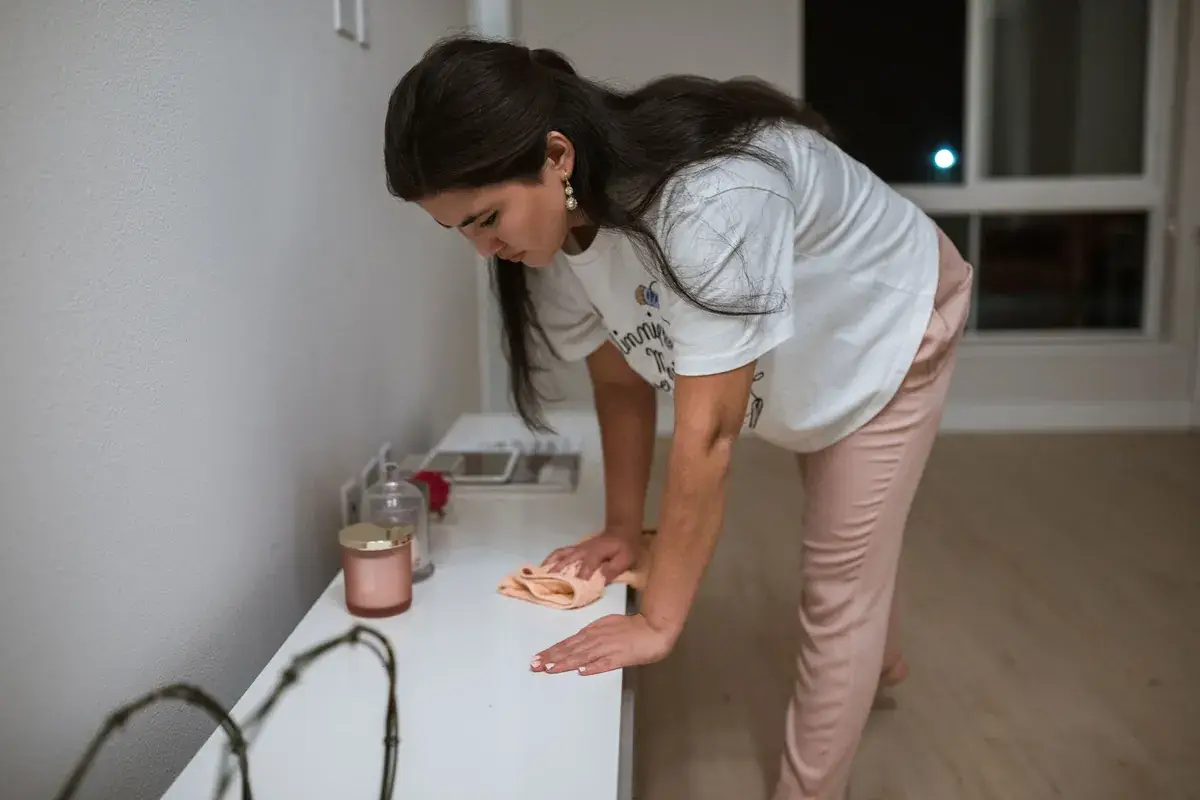
Think of this part as a walk. If you live alone, the loop is two minutes. In a flatshare you only carry your own things, so it’s quicker again. Go from the kitchen through the living room to the bedroom and back, picking up anything that is in the wrong room. Mugs go to the sink, clothes to the chair or the laundry basket, post to the in-tray, and shoes to the door.
 Photo: cottonbro studio via Pexels
Be strict about the floor, and do it for safety rather than appearance. The NHS advice on preventing falls is to not have too much clutter at home, or things you could trip on such as loose wires or rugs. A phone charger trailing across the bedroom floor, or a bag dropped in the hallway, is precisely the thing you trip over at two in the morning on the way to the bathroom. Whatever else is still lying around when the five minutes run out, clear the floor between the bed and the bathroom door and between the bed and the front door.
Give the surfaces a quick wipe with the same cloth you used in the kitchen: the coffee table and the bedside table, since those two gather the most clutter. Leave the vacuum out of it. If the rug needs doing, that can wait for the weekend. The point of the reset is to stop the flat getting worse; making it better is a different job.
Minute 11 to 15: the bedtime round
This section can look like overkill until you read the fire brigade’s bedtime page. The London Fire Brigade says about a third of all fires they attend are at night, which is when you are least able to cope with one. None of this had crossed my mind before I moved out. Their checks boil down to four things you can do on your way back to the kitchen for the kettle:
- Close all internal doors. The guidance says to close all your internal doors to prevent smoke spreading if a fire starts. In a flat that is three or four doors and roughly twenty seconds.
- Chargers. The guidance says not to leave mobile phones, tablets or e-cigarettes charging overnight. If you charge your phone on the kitchen worktop while the kettle boils and unplug it before bed, the routine doesn’t gain a step.
- Hob and oven. Check that the hob and oven switches are all off. You already did this in minute one, but the bedtime page says to check, so check again. It takes two seconds.
- Escape route. Make sure escape routes are clear of anything that could slow you down. In a flat, that is the hallway from the bedroom door to the front door: no bag, no bike, no shoes across the floor, and keys on a hook you can find in the dark.
Then the kettle goes on, and you finish when the timer rings or the tea is ready, whichever happens first. If you share, the last person to bed does the bedtime round, regardless of whose reset night it was.
What to deliberately leave until the weekend
The reset only lasts if you stop it from growing. Keep these out of it, however much they annoy you:
- Vacuuming or mopping.
- Cleaning the bathroom, apart from hanging the towel up.
- Changing the bed.
- Sorting post, apart from putting it in the in-tray.
- Cleaning the oven, the hob, the fridge or the extractor.
- Putting a wash on. If the laundry isn’t in the machine by seven, it is tomorrow’s laundry.
All of those go on a short weekend list, and the list can stay short because the reset has kept the floors and surfaces clear all week. I laid that list out in a weekly cleaning schedule for two working adults. It is brief because there is no putting-away to get through first.
Making it stick: attach it to something you already do
“After dinner” is not a fixed moment. It’s a vague stretch of evening that slides towards the sofa, and a routine tied to it won’t make it through the first bad week. I would tie it to something you never skip: putting the kettle on for a last cup of tea, locking the front door, plugging the phone in. Kettle on, timer started, and off you go. The tea is ready at roughly the point the kitchen is done, so you can do the walk-through with the mug in your hand.
Two smaller habits help. Keep the cloth and the spray in one fixed place so you never have to look for them. And turn the lights up fully for the reset, because in the half-dark you miss the mug behind the lamp and discover it still there on Friday.
The reset won’t make the flat clean. What it does is keep the flat on Thursday looking the way it did on Monday, which I think is the more useful thing. The routines that build on it are in the organisation section.