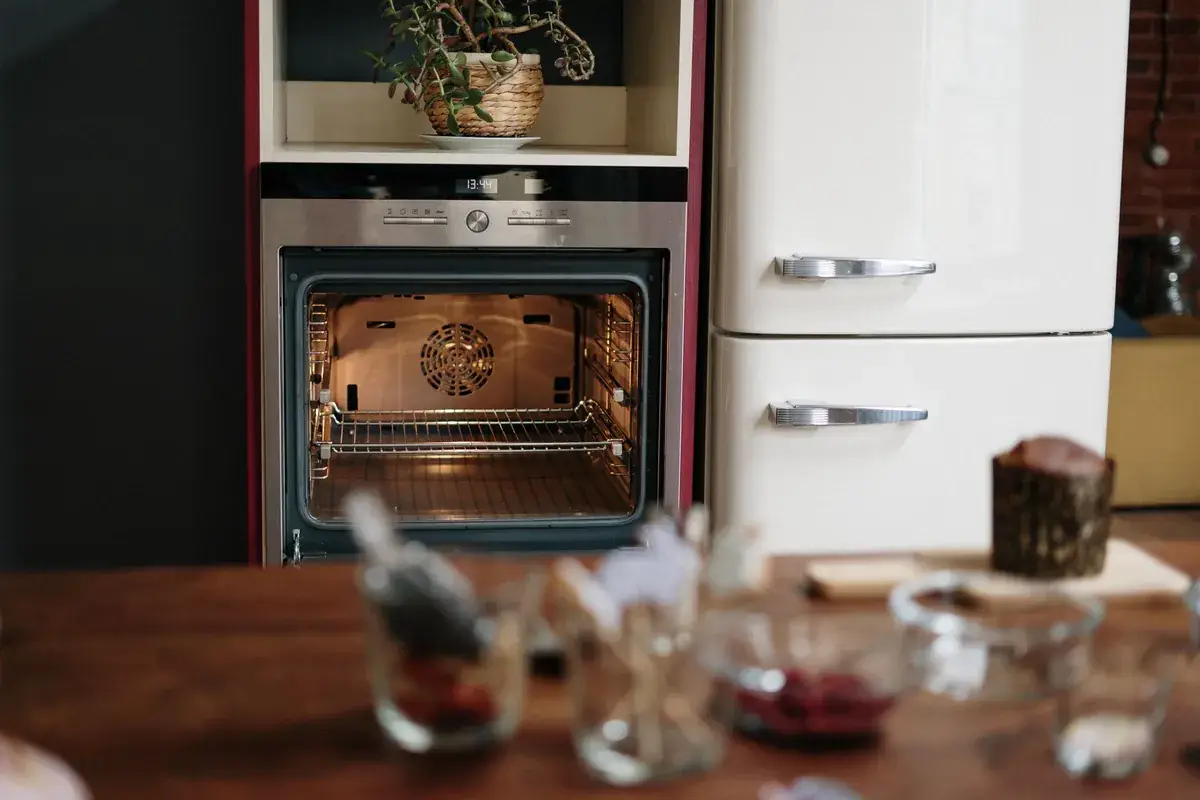
Yes, bicarbonate of soda will clean an oven. It takes a whole night rather than twenty minutes, and there are marks it won’t shift at all. You spread a thick paste over the baked-on spatter, leave it overnight, and by the morning most of the mess is soft enough to wipe off. Beko, which makes ovens, gives this exact method in its own guide, so this isn’t a folk remedy. Where the paste struggles is the racks and the door glass, and that is where you have to decide whether a caustic product is worth its warnings.
First check what kind of oven interior you have
Work this out before choosing a method, because the wrong one damages two of the three types. I didn’t know there were three types at all until I read the guides.
Plain enamel. This is the electric oven most rented flats have: smooth and glossy inside, dark grey or black. Bicarbonate is fine on it, and so is a caustic cleaner if you go that way. Everything below applies to you.
Catalytic liners. Some ovens have rough, matt panels on the sides and back that feel slightly porous. They soak up grease and burn it off at high temperature, and Beko’s guide says they don’t need cleaning because they clean themselves once the oven gets to 200°C. Scrub them, or plaster them in bicarbonate, and you clog the surface so it stops doing its job. Clean the enamel floor and the door as usual and leave the liners alone.
Pyrolytic. These run a self-cleaning programme that heats the inside “up to 480 degrees Celsius” and reduces the residue to ash. Beko mentions a “120-minute cycle or an Eco cycle that runs for 90 minutes”, and says to take out all the trays and side racks beforehand. Owners of one get a third option, and bicarbonate paste shouldn’t go on a pyrolytic liner either. If you can’t tell which you have, the model number is on the door frame.
Beko’s guide also asks you to check, before you begin, that whatever product you use suits your oven’s interior.
The overnight bicarbonate paste, step by step
Beko’s instructions for “hard to clean areas” are brief: “Make a paste with baking soda and water. Place this over problem areas and leave to sit overnight. In the morning, wipe off the cleaning paste and spray the oven’s interior with vinegar”, followed by “Clean the oven’s interior thoroughly using water.” Baking soda is just the American name for bicarbonate of soda.
In a typical small flat, with a standard electric oven and no extractor, the method goes like this.
- Pick an evening after the oven has been used for the last time that day, once it is completely cold. Take out the racks and any trays.
- In a bowl, mix bicarbonate with a little water until it is roughly as thick as toothpaste. Spreadable paste clings to the walls; runny paste slides down to the floor of the oven. An ordinary single oven will use up most of a small tub.
- Using a spatula or a gloved hand, cover the floor, the walls and the inside of the door, going thickest over the burnt patches. Keep it away from the fan cover at the back, the heating element and the door seal.
- Leave it overnight.
- The next morning, scrape and wipe it out with a damp cloth or a plastic scraper, then spray the inside with vinegar. Anywhere the vinegar hits leftover bicarbonate, it fizzes, and that fizzing lifts the last of the residue.
- Wipe the whole thing down with clean water, and change the water at least twice. Bicarbonate you miss will smoke and smell the next time the oven goes on.
What the paste can’t do is dissolve the black, glassy carbon that has been cooked on over and over. It softens fresh and moderate spatter, and that is where it stops. Older patches need a second night, a scraper, or something stronger.
Racks and the door glass: where bicarbonate struggles
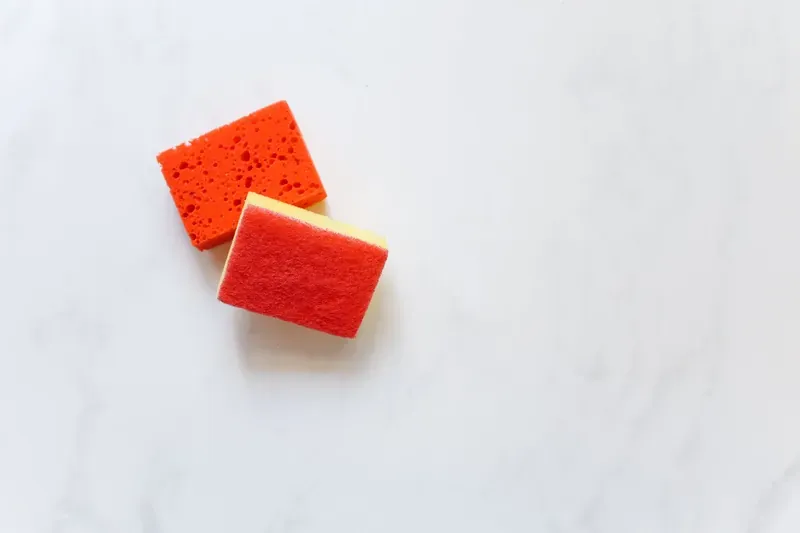 Photo: Polina Tankilevitch via Pexels
Racks are the fiddly bit of cleaning any oven. The grease is on wire rather than a flat surface, and paste simply won’t stay on a wire overnight.
So soak them. The bath is the obvious place; if there isn’t one, a large bin liner in the sink works. Lay an old towel in the bottom of the bath to protect the enamel, and put the racks on top. Add hot water, a generous squirt of washing-up liquid and a couple of handfuls of bicarbonate. Give it a few hours or a night, and most of the grease will come off with a scouring sponge, which is rough enough for chrome racks without scratching them the way wire wool would. If you live in a shared house, tell everyone before you do this: a bath full of oven racks on a weekday evening is exactly how arguments start.
The door glass is a different problem. Paste sits on it happily enough, but the deposits there tend to be thin, even and baked hard, so a night softens them without actually lifting them. A plastic scraper or an old bank card, held at a shallow angle, will take off whatever the paste has loosened. Don’t use a metal blade on the glass.
Whatever survives a soak and a scrape is what drives people to the caustic stuff.
What caustic cleaners actually are and why the label is so blunt
Most heavy-duty oven cleaners are based on sodium hydroxide, more commonly called caustic soda. It turns fat into soap, which is why it gets through baked-on grease so quickly, and it does the same to skin. That’s the chemistry, not scaremongering.
Oven Pride’s own listing carries the hazard statement “Causes severe skin burns and eye damage”. The instructions say “Leave to soak for 4 hours, ideally overnight” and “Ventilate the room during and after use”. The list of don’ts is long: do not “Use on a hot oven”, do not “Use on aluminium, zinc, copper, tin, painted, damaged, self-cleaning or non-stick surfaces”, and keep the solution away from the “glass oven door, door seals”.
Compare that list with the oven in a rented flat. The door seal is rubber, and caustic breaks rubber down. A non-stick tray or an aluminium baking sheet put in the bag with the racks will come out grey and ruined. The label also rules out the glass, which means the caustic product is no help in the one place bicarbonate was weakest.
Put them next to each other. Bicarbonate is slow, needs a night and leaves some carbon behind, but it can’t harm you, the oven or your deposit. Caustic cleaner is quick and thorough on racks and enamel, and its label tells you plainly what it does to eyes and skin. For a small kitchen without an extractor, I would treat the slow method as the default.
If you do use one: cold oven, gloves, windows open, nowhere near the seals
There are times when a caustic product is the only realistic option: maybe the racks are beyond what soaking can fix, or the oven has to go back to the landlord spotless. If so, do exactly what the label says.
- Only use it on a cold oven. The label rules out a hot one, and heat makes the fumes worse and speeds up the reaction.
- Wear gloves that come up past the wrist; that long pair in the box isn’t there for decoration. Wear eye protection if you have any, and if not, keep your face well back from the bag and the oven.
- Open the windows before starting and keep them open afterwards, because the label says to ventilate “during and after use”. Without an extractor, open the kitchen window and one in the next room so the air actually moves.
- Keep it off the door seal, the glass and any aluminium or non-stick tray. Only the racks go in the bag.
- Leave it for 4 hours of contact at the very least, and overnight if you can. Then rinse the oven and racks with clean water several times, because any residue left behind ends up in your next roast.
- Don’t mix it with anything, and don’t use it in the same session as an acid descaler or bleach in the same room.
Keep what’s left with the cap on, somewhere high up and away from food. If you share the kitchen, let people know it’s in the oven overnight, so nobody wanders in at midnight and preheats it for a pizza.
Keeping it clean between deep cleans
The weekly cleaning schedule puts the oven in the “rarely” tier, meaning two or three times a year. What keeps it there, instead of creeping up to monthly, is stopping spatter from reaching the enamel to begin with.
Line the roasting tin with foil or baking paper, and put a tray on the shelf below anything that might drip. Batch-cooking days are the riskiest: with three trays in, something is going to bubble over. The cooking side of that is covered in the piece on what freezes well. A lined tray costs pennies and spares you a night of bicarbonate.
Whenever something has spat, wipe the oven floor while it is warm but not hot. Fresh fat lifts off with a damp cloth. Let the same fat bake on for another six weeks and you will be scraping it instead.
Whether the overnight method is enough for your oven comes down to those three habits. The rest of the kitchen and bathroom routines are in the cleaning section.