A weeknight pantry is a short list of tins, jars, dry goods and freezer staples, and every item on it becomes a dinner once you add one fresh ingredient. The whole thing fits in one cupboard: tinned tomatoes, chickpeas, beans, tuna, coconut milk, passata, a curry paste, pasta, rice, red lentils, couscous, stock cubes and oil, plus peas, spinach, sliced bread and grated cheese in the freezer. Once that is in place, “there’s nothing in” stops being true, and in a small flat that solves most of the problem.
The rule: everything on the list must make a meal with one fresh ingredient
There is one test for whether something gets cupboard space. Will it make a dinner with a single item from the fridge, or with nothing at all? An onion and a tin of tomatoes are a pasta sauce. Chickpeas, curry paste and coconut milk are a curry. Tuna, pasta and frozen peas are a dinner with no fresh food involved.
Anything that needs three other fresh things before it is usable is a recipe ingredient, and it stays off the list. That rule is what stops the odd jar bought for one dish and then never opened again. In a rented flat with one cupboard for all of this, there is no space for a tin that only suits a meal you make once a year. In a shared house, where your cupboard might be a single shelf, the rule is even harder to argue with.
What follows is everything that passes. I kept it deliberately dull, since the dull things are what people actually eat.
Tins and jars
- Chopped tomatoes, four tins. Most weeknight cooking begins here.
- Passata, one carton or jar. It gives a smoother result than chopped tomatoes when you want a quick pasta sauce.
- Chickpeas, three tins. Curry, salad, or mashed onto toast.
- A second bean, kidney or cannellini, two tins. Chilli, soup or a bean salad.
- Tuna, two tins. Pasta, a jacket potato or a cold lunch.
- Coconut milk, two tins.
- A curry paste in a jar. One jar of one kind is enough, and it goes in the fridge once opened because the label says so.
- Stock cubes, one pack.
- Olive oil or rapeseed oil, along with a small bottle of vinegar.
- Soy sauce and a jar of peanut butter. Stirred together, they make a sauce for noodles or for rice with frozen veg.
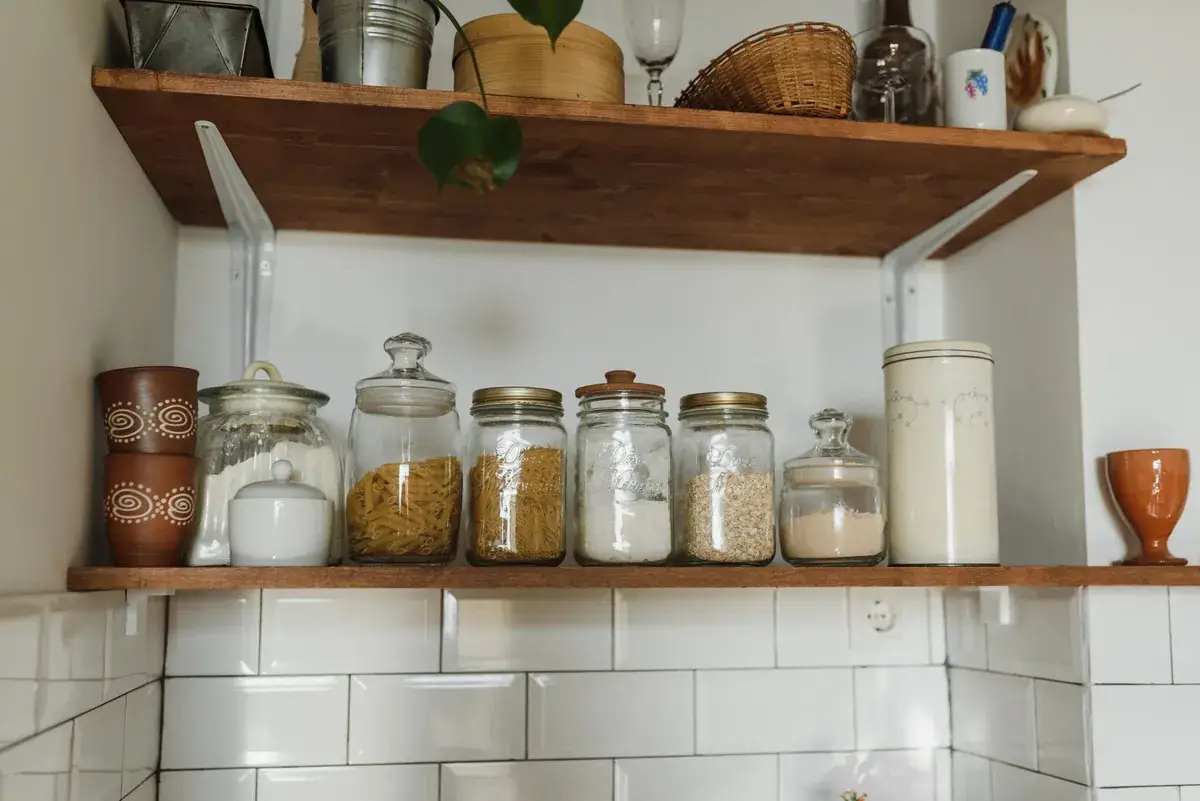
That is the whole tin-and-jar shelf. The quantities are sized to what one shelf can hold without doubling up, so think of it as a working stock rather than a stockpile. When you get down to the last tin of anything, it goes on the shopping list.
Dry goods and how much to keep
This is where the amounts get exact, because the British Nutrition Foundation publishes single-portion weights for dried starches, which means you can count a bag in dinners. Its portion guide puts dried pasta at 75g and dried rice at 65g for an adult, dried lentils at 50g (about two handfuls) and dried couscous at 90g (also about two handfuls). The same guide recommends 3-4 portions of starchy food a day across all your meals, so dinner accounts for one and the other meals cover the rest.
Measured against ordinary supermarket pack sizes, the numbers work out like this:
- A 500g bag of pasta is roughly six or seven single portions, or three dinners for two.
- A 1kg bag of rice comes to about fifteen single portions.
- A 500g bag of red lentils is ten portions. Red lentils need no soaking, which is why they are the practical pick on a weeknight.
- A 500g box of couscous is five or six portions, and it is ready in roughly the time the kettle takes to boil.
Keep one open bag of each and one spare, and restock as soon as the spare gets opened. Cooking for two with a partner means the bags go twice as fast, but the weight per portion does not change, so the marked mugs further down still work. The NHS suggests you choose wholegrain varieties where you can, and the cupboard is the easiest place to do it: buy wholewheat pasta and brown rice once, and that is what you find at 7pm. The healthy choice gets made in the shop, not on the night.
Weigh out 65g of rice and 75g of pasta once, and mark a mug for each. From then on a bag lasts as long as the sums say it should, because the pan stops getting overfilled. It is a very small fix, and I like it more than I thought I would.
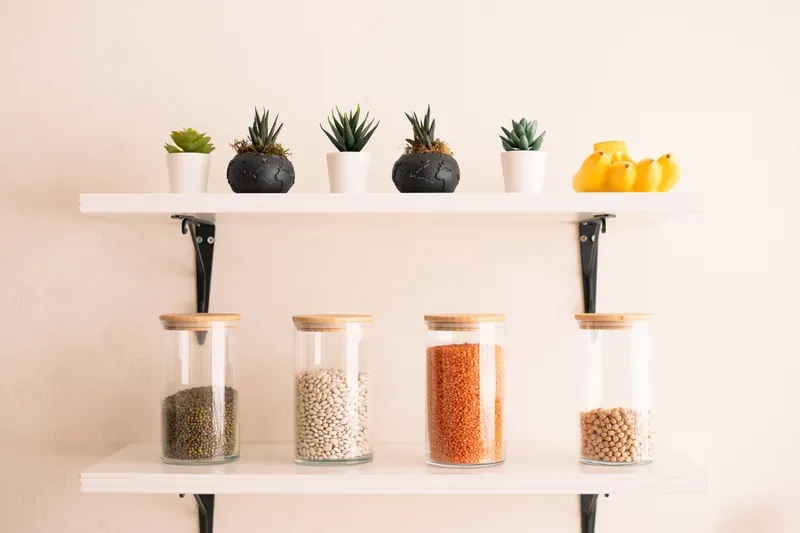 Photo: Gülşah Tüfekçi via Pexels
Freezer staples that count as pantry
For the purposes of this list, one drawer of the fridge-freezer is part of the cupboard. Whatever goes in there keeps for months and takes no planning:
- Frozen peas. These are the fresh ingredient in a tuna pasta, a risotto or a curry.
- Frozen spinach. The blocks go straight into a dal or a sauce.
- Sliced bread. Always have half a loaf frozen; it toasts straight from the freezer. Beans on toast, cheese on toast and eggs on toast are all dinner, and I see no point pretending they are not.
- Grated cheese. With a bag in the freezer, a pasta bake or a cheese topping is always an option. It turns slightly crumbly but melts fine.
- A bag of mixed frozen vegetables or frozen sweetcorn, for a stir-fry or fried rice.
Bread especially belongs in the freezer, and the next section explains why.
Potatoes, onions and garlic: the cool dark corner
Three fresh items live with the tins, because if they are stored properly they last far longer than anything in the salad drawer: potatoes, onions and garlic. The NHS says that keeping potatoes in a cool, dark and dry place or in the fridge will help stop them sprouting, and that you should not eat any parts that are green, damaged or sprouting. In most flats the cool, dark corner is the bottom of a cupboard on an outside wall. The potatoes go there in the paper bag they came in, not a plastic one, the onions sit beside them without touching, and the garlic goes on the shelf above.
According to WRAP, UK households throw away 960 tonnes of bread a day (24 million slices) and 1,300 tonnes of potatoes a day (8.2 million potatoes), and nearly 40% of household food waste is food that was not used in time. In other words, the cheapest, most basic food gets binned far more than anything fancy, which I did not expect when I looked it up. It is the reason bread goes into the freezer the day it is bought, and potatoes go somewhere dark rather than into the fruit bowl by the window.
Out of the dinners on this page, a jacket potato topped with tuna, cheese or beans from the list is the one I would count on when you have not been shopping, and it needs nothing but an oven.
Five dinners the list makes on its own, and the restock trigger
None of these takes more than one fresh item, and most take none:
- Chickpea and spinach curry. Curry paste, a tin of chickpeas, coconut milk, frozen spinach and rice. Nothing fresh is needed, though an onion makes it better.
- Tuna, pea and lemon pasta. Pasta, tuna, frozen peas and oil, with a lemon or some cheese if either is around.
- Red lentil dal. Red lentils, a tin of tomatoes, stock, curry paste and frozen spinach. Have it with rice, or with the frozen bread toasted.
- Bean chilli on a jacket potato. Kidney beans, chopped tomatoes, an onion from the dark corner, a potato from the same place, and grated cheese from the freezer.
- Couscous with roasted veg or, failing that, chickpeas, peas and a soy-and-peanut dressing. Couscous, stock and whatever is in the freezer.
The spare is what triggers the restock. When you open the second bag of pasta or the last tin of tomatoes, write it down, and that note goes with the fresh items on the one weekly shop. Apart from that one spare, nothing gets bought “just in case”: there is no room for it in the cupboard, and going by WRAP’s figures, “just in case” food is exactly what ends up in the bin.
Getting all of this into one cupboard in a small kitchen is a matter of rearranging, not buying new containers, and I go through that in organising a small kitchen without buying anything. The rest of the meal planning section is about what to cook once the cupboard is full.