Limescale comes off with acid, and the usual three options are vinegar, citric acid or a branded descaler. Which one is safe depends on the fixture. For a kettle, use a product the manufacturer allows. For a shower head, use whatever its own manual permits. For a tap, it comes down to the finish. Before soaking anything, find out how hard your water is and what the fixture is made of, because those two facts decide how often you descale and whether acid should go near it at all. I had no idea about either until I looked them up.
Find out how hard your water actually is
Hardness is measured in milligrams of calcium carbonate per litre, and your supplier publishes the figure for your postcode. Thames Water sorts it into bands: Soft “up to 100”, Slightly hard “100 -150”, Moderately hard “150 - 200”, Hard “200 - 300”, and Very hard “More than 300”. It also says, without any hedging, that “all the water in our region is hard”.
Find your own supplier’s number and see where it lands. From 200 upwards, a kettle element can crust over in around a month, and a shower head can start spraying sideways within a few. The rest of this article assumes that end of the scale. If you are only slightly hard, the methods are identical; you just need them less often.
Acids and finishes: what is safe on plastic, chrome, brass and stone
Every descaler does the same basic thing. The acid reacts with calcium carbonate and turns it into something that rinses away. Where products differ is strength, and what else they damage along the way.
According to the Viakal product information sheet, its neat pH is 2.2, which is strongly acidic. The sheet also names surfaces to keep it away from: “old enamel, plastic water boiler, marble or natural stone, silver, gold, copper and aluminum”. Of everything on the sheet, that list was what I found most useful. Marble and stone are calcium carbonate as well, so the acid will eat a worktop just as happily as it eats scale. Copper, brass and aluminium fittings end up discoloured or pitted. Gold-coloured and “brushed” tap finishes are often just a thin layer over brass, and acid can take them off. And “plastic water boiler” on the list is the sheet’s way of saying a bathroom limescale spray does not belong in a kettle. Kettles get their own product.
The typical tap in a rented flat is chrome-plated brass, which the sheet includes in its intended uses (“taps, showers”) provided contact is kept short. The plating is thin, though, and long soaks repeated over time will wear through it. Plastic is fine with citric acid and vinegar, which is exactly why those two are the usual picks for kettles.
Whatever you end up using, the precautions don’t change. Wear washing-up gloves, open a window, rinse everything with clean water when you finish, and never combine a descaler with bleach or any other cleaner. Mixing acid and bleach gives off a harmful gas, and the bathroom is the riskiest room since both products usually get kept there. The toilet is where the two most often meet in the same bowl, so that gets its own piece: descaling a toilet without the fumes. If you live in a shared house where three people might each have bought a different bottle, actually say this to each other.
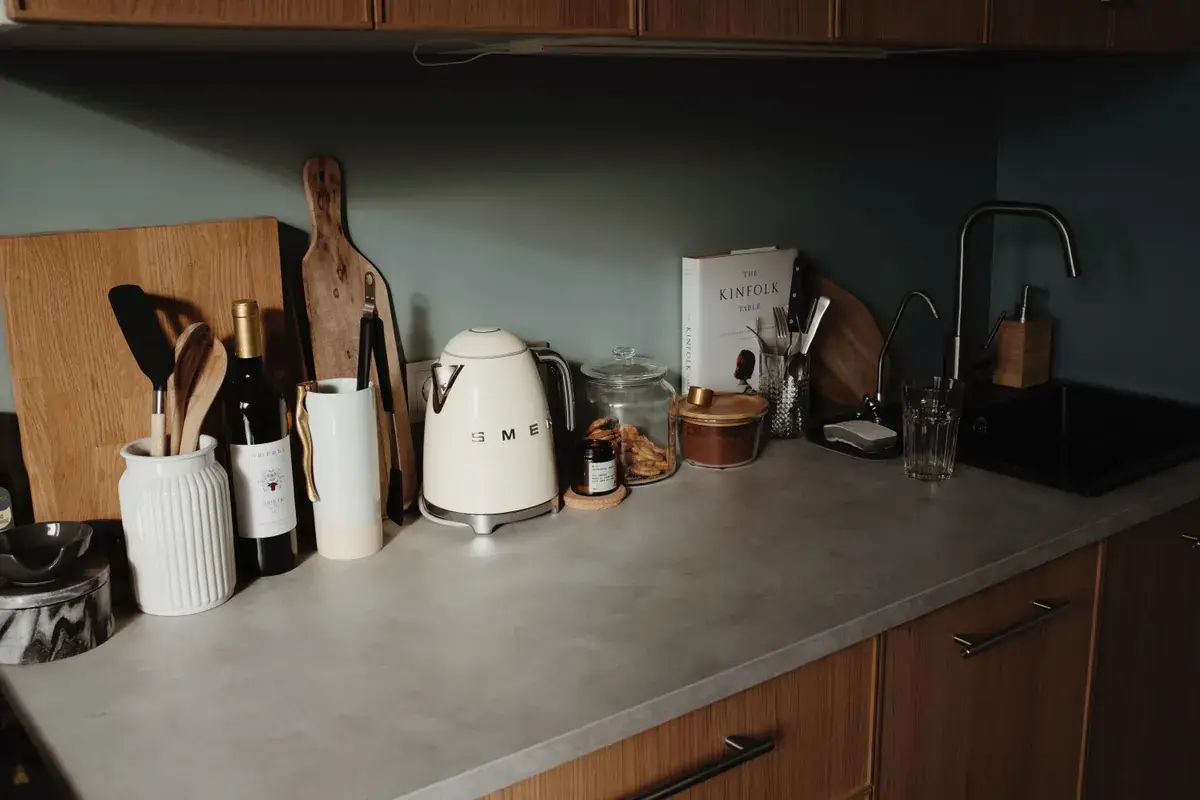
Kettle: what the manual allows and the rinse-boil-empty step
Start with the manual, since that is where the guarantee terms are. The Russell Hobbs kettle instructions say to “Use a descaler suitable for plastic products (all kettles have plastic parts)”, and the guarantee section goes on: “Products returned under guarantee with faults due to scale will incur a repair charge.” Put simply, scale damage is on you, and so is anything the wrong product does to the plastic.
Here is the method:
- Fill the kettle to the maximum line with cold water, then add descaler at the dose on its packet. The manual only says to “Follow the instructions on the descaler”. Citric acid sachets and kettle descalers give a quantity per litre, so go by that rather than guessing. If you would rather use vinegar, check the kettle’s manual allows it, because not all of them do. It smells, too, so open the window.
- Do what the packet says, which will be either to boil it and leave it or to leave it cold for longer. Branded descalers usually need minutes; citric acid takes longer on a badly crusted element. Only leave it overnight if both the packet and the manual say that is fine.
- Pour it away and check the element. If there is still white crust on it, soak it again instead of scrubbing.
- Finish the way the manual tells you to: “rinse, fill, boil, and empty, to avoid residues”. Doing the rinse-boil-empty twice costs almost nothing and saves you a sour first cup of tea.
It takes around ten minutes of actual attention, and it fits easily on the same day as the shower head soak. What surprised me was the manual saying kettles need this regularly “even in soft water areas”. That accounts for the thin film you still get in a kettle in a soft-water area after a year.
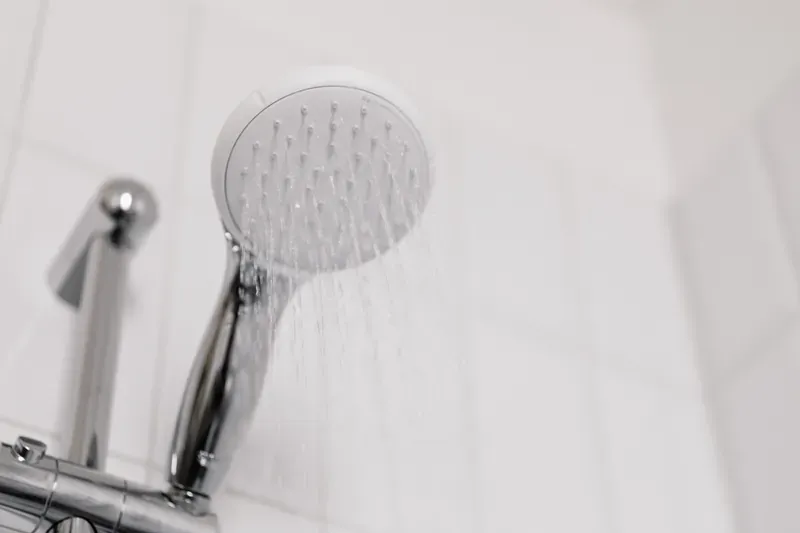 Photo: Kaboompics.com via Pexels
Tap: the bag-over-the-spout method and how long to leave it
Taps collect scale in two spots. The first is around the base, where drips sit and dry. The second is the aerator at the tip of the spout, where scale blocks the mesh and makes the water spit.
For the spout, half-fill a small freezer bag with descaler, diluted as the packet says. Draw it up over the spout until the end is under the liquid, then fix it in place with an elastic band. Leave it for the contact time given on the product, and not a minute more. On encrusted scale, the Viakal sheet says “Leave to act for a few minutes before rinsing and repeat if needed”. So: a few minutes, rinse, check, and go again if scale is still there. Leave it on for an hour and the chrome plating starts to go.
Most mixer taps let you unscrew the aerator if you grip it through a cloth. If it comes off, put it in a cup of the same solution. That way the acid gets at the mesh from both sides and the chrome is left alone.
For the base, wet a strip of kitchen roll in the solution, wrap it around, and give it the same few minutes. Rinse it and dry it. The drying matters, because it stops the ring coming straight back.
Check what the finish is before you start. Brass, copper, gold-effect or anything that isn’t plain chrome is on the Viakal list above, so keep the product off it. And remember that even a cheap chrome tap in a rented flat is still the landlord’s.
Shower head: unscrew if you can, check the manual if you cannot
If the shower head unscrews from its hose, it is the easiest thing in a flat to descale. Take it off and sit it in a bowl or the basin with descaler at the packet dilution. Give it the contact time on the packet, rinse it, and poke out any blocked holes with a cocktail stick. Then run the shower for a minute before getting in, so any leftover acid is flushed through.
The harder case is a head that won’t come off, or a fixed head on an electric shower. Triton is blunt about it: “Before soaking a showerhead or using vinegar, cirtric [sic] acid or another descaling product, check the cleaning guidance in the shower manual. Some chemicals can damage finishes, seals or internal components if they are used incorreclty [sic].” Behind the head of an electric shower sit rubber seals and a heater tank, and no manufacturer’s guarantee is going to cover acid that has seeped back into them.
If the flat didn’t come with the manual, look for the model number on the sticker most units have and download the PDF from the manufacturer’s website. If that still turns up nothing, use the bag method from the tap section instead: outside of the head only, a few minutes at most, and no acid travelling up the hose.
Store the descaler, citric acid and spare kettle sachets together in a single lidded box, well away from the bleach. The reasoning is in under-sink storage that survives leaks.
How often, and the cheap habit that halves the work
For the hard band, begin with monthly for the kettle and shower head and quarterly for the tap, then adjust based on how the element looks. If your water is only slightly hard, double those intervals. I would put the kettle in a calendar. A scaled element takes longer to boil and uses more electricity, and the kettle is the one appliance whose guarantee states plainly that scale is excluded.
Drying cuts the work in half. Hard water leaves scale behind as it evaporates, so wiping the tap dry after the washing-up and squeegeeing the shower screen after every shower means there is less water left to evaporate. It takes thirty seconds, and it means the monthly soak deals with one month of scale rather than a whole season’s.
The other cheap habit is to empty the kettle after using it instead of leaving water sitting in it. Standing water evaporates onto the element, so a kettle kept empty scales more slowly than one kept full. Combine that with a dry tap and the monthly routine comes down to a soak, a rinse and very little scrubbing. The other limescale articles, including the toilet one, are in the cleaning section.