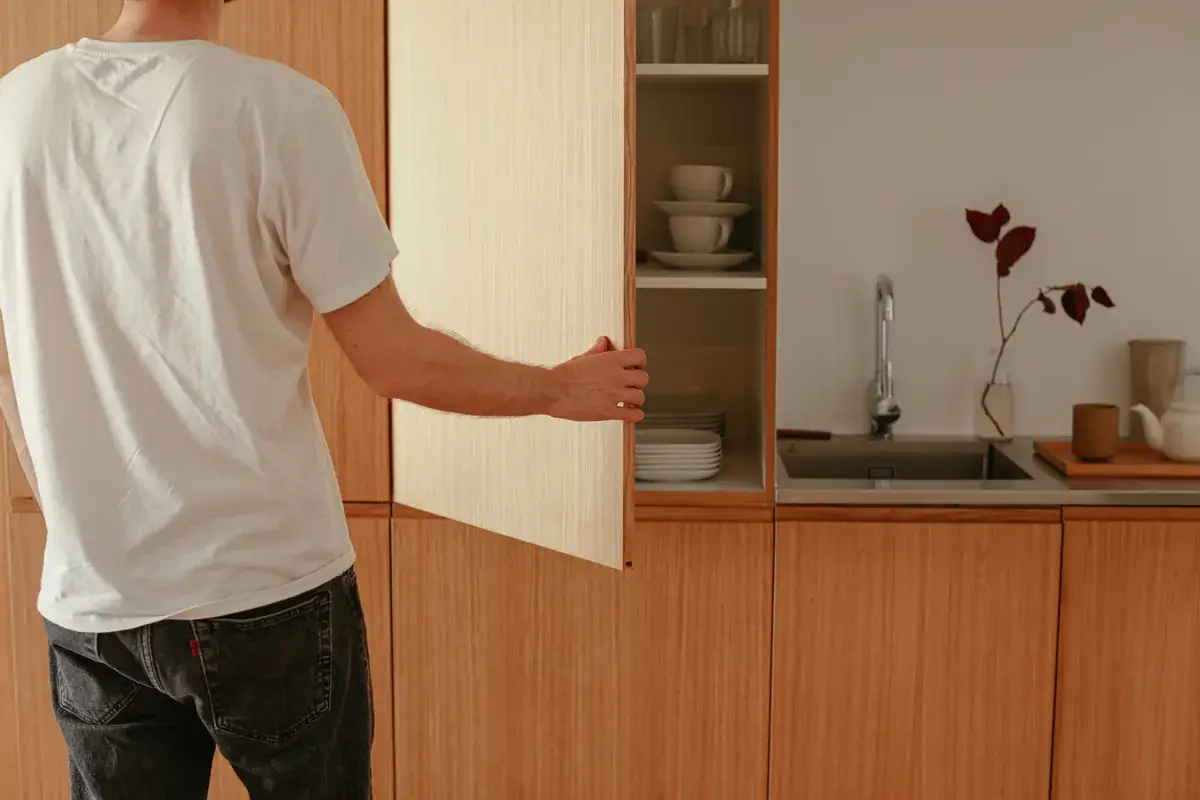
Keep the floor of the cupboard under a rented kitchen sink completely clear. Then a leak shows up within a day instead of a fortnight, and you can get to the stop tap without emptying anything. In practice that means a lidded plastic tub or two for cleaning products, a tray under the bottles that drip, and a flat sheet of kitchen roll or newspaper on the floor as a tell-tale. If water does appear, the landlord fixes it; your part is to photograph it, report it and keep a record. That split is the same whether you live alone, with a partner, or as one of four names on a shared-house tenancy.
Two facts decide the layout. Hard water scales up tap fittings and wears out washers, so in a hard-water area the joints under the sink are often the first thing in the flat to start weeping. And in most rented kitchens the waste pipe goes straight through the middle of that cupboard, which means you are storing things around it whether you want to or not.
What is actually under the sink
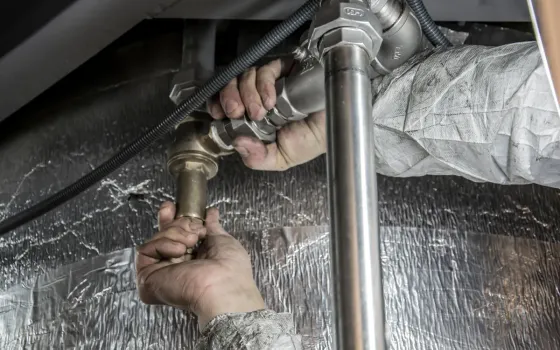
Empty the cupboard once and have a proper look. There are usually four things in there: the waste trap (the U-bend under the plughole), the flexible or copper pipes taking hot and cold water up to the tap, the stop tap or isolation valves on those pipes, and, if the kitchen has a washing machine, its supply valve and waste hose.
Most leaks begin in one of two spots. One is the trap and its compression joints, which loosen over time or crack when something heavy gets shoved against them. The other is the tap tails and isolation valves, which fur up in hard water and drip from the compression nuts. Either way it starts slowly, a drip every few minutes, and you will not notice it unless the cupboard floor is clear.
While you are down there, find the stop tap. Expect a small brass tap with a wheel or lever on the incoming cold pipe, or isolation valves with a screwdriver slot on each tail. Give it one turn to check it moves. If it has seized, tell the landlord now rather than on the day you need it. In a shared house, show everyone where it is, because the person who finds the leak will probably not be the one who read this.
Nothing on the floor: tubs, a tray and a tell-tale sheet
The one rule: nothing sits directly on the cupboard floor. Water gathers there first, and a chipboard base swells and stains quickly once it is wet.
None of this needs buying:
- One lidded plastic tub (an old storage crate will do) for the cleaning products. You can lift the lot out in one go to clean underneath, and if a bottle leaks, it leaks into the tub and nowhere else.
- A shallow tray (a baking tray that has seen better days) under the bottles that drip, which means the descaler, the vinegar and the bleach. In a hard-water flat the descaler comes out often enough that its cap never fully dries; using it on the kettle, tap and shower head is explained in how to descale a kettle, tap and shower head.
- A sheet of kitchen roll or a page of newspaper laid flat on the cupboard floor, under the trap and the tap tails. This is the tell-tale, and if I had to drop everything else on this list, it is the bit I would keep. Dry paper stays flat and white. One drip leaves a ring you cannot miss. It costs nothing, and it gets you to the leak the next day rather than a fortnight later.
Keep the stop tap at the front, where your hand can reach it without shifting the tub. If reaching it means unloading the cupboard, the layout is wrong.
 Photo: Ron Lach via Pexels
What belongs here and what should move
This is the dampest, most awkward cupboard in the kitchen, so give it things that do not mind damp: washing-up liquid refills, surface spray, bleach, descaler, white vinegar, bicarbonate of soda, bin bags, cloths, spare washing-up brushes, and the dustpan if it fits.
Everything else goes. That includes all food, tins and unopened packets as well, since a leak or a knocked-over bottle of bleach will spoil it. It includes tea towels and paper, which absorb damp and turn musty. It includes anything electrical, and anything you use daily, because crouching down for it every time gets old within a week. The washing-up liquid you are actually using lives on the side by the sink; only the refill goes in the cupboard.
With the food gone, the cupboard is roughly half as full, and that is the space you need to see the tell-tale sheet and reach the stop tap. The same idea applies to the rest of the kitchen, grouping things by how you use them rather than by what each cupboard was supposedly for, and it is laid out in how to organise a small kitchen without buying anything.
Keeping cleaning products in their original bottles
Do not decant anything. Tipping bleach or descaler into a tidier bottle is tempting, but the NHS guidance on preventing poisoning says to keep liquid cleaning products and chemicals in their original containers to avoid them being mistaken for drinks. The original bottle carries the hazard label, the instructions and a child-resistant cap. An old squash bottle carries none of those.
The same NHS page says to keep these products out of children’s reach, ideally in a locked cupboard, and to put safety catches on low cupboards holding harmful substances such as cleaning products. The cupboard under the sink is the lowest in the kitchen, so if children visit or live in the flat, that is where the catch goes. Stick-on or adhesive catches need no drilling and come off a rented cupboard without leaving a mark. The lidded crate also adds one more lid between small hands and the bleach.
The monthly check and the 30-minute meter test
Once a month, open the cupboard and look at the tell-tale sheet. Attach it to a monthly job you already do, such as changing the bed, and it takes ten seconds. Dry and flat means shut the door. A ring means running a dry finger along the trap joints and tap tails until you hit the wet one, then putting down a fresh sheet.
Not every leak is visible, and for some the first clue is a musty smell or a swollen patch on the cupboard base. For those, Thames Water’s method for tracking down a hidden leak works in any home with a water meter: turn off every appliance that uses water and the inside stop valve, then compare two meter readings taken 30 minutes apart. If the meter has moved while everything was off, water is getting out somewhere. Their numbers on what this costs caught me off guard: even a small trickle of water can waste up to 200 litres of water per day, and a leaky loo can waste an average of around 400 litres of water a day. In a metered flat, that comes out of your pocket.
When you find water: photograph, report, log
The day you find a leak, take photos on your phone before touching anything. If you share the flat, whoever finds it takes the photos, rather than waiting for whoever is named first on the tenancy. Get the wet sheet, the drip on the joint, the swollen base, and any damage to what was stored in there.
Next, move the tub somewhere dry and put a towel or a washing-up bowl under the drip. If it is more than a drip, shut the stop tap or the isolation valve on that tail.
Then email the landlord or agent. A phone call alone is not enough. Say what you found and when, attach the photos, and ask when someone can come out. Shelter’s repairs advice is to report any repairs to your landlord as soon as possible and to keep a record of what you told them and when. Forward the email to yourself with the flat’s address in the subject line so it is easy to find later, and put a printed copy in the tenancy folder of the paper filing system, alongside the deposit certificate and the check-in photos. If the deposit is ever disputed, that dated email proves you reported the leak promptly and did not let it get worse.
Whose repair it is
It was a relief to find there is no grey area here. Shelter’s page on repair responsibilities lists what a landlord has to deal with, and that list includes pipes, sinks, baths and toilets, and plumbing and drains. In their words, your landlord is always responsible even if your tenancy agreement does not say so. A dripping trap, a weeping tap tail, a failed isolation valve and a swollen cupboard base are all the landlord’s to fix.
Your job is to report it quickly, not make it worse, and keep your hands off the plumbing. I would not go near the compression nuts under a rented sink. Overtighten one, crack the trap, and a leak you spotted and reported the same day becomes an argument about who caused the damage.
The tub, the tray and the sheet of kitchen roll are the whole system, and all they handle is a slow drip. When a pipe bursts outright they are no help at all, and what matters then is whether you can find the stop tap in under a minute. The piece I would read next is finding your stopcock before you need it, which covers where it usually is and what to do, in order, in the first five minutes. For the same nothing-on-the-floor thinking applied to the rest of the kitchen, see the organisation section.