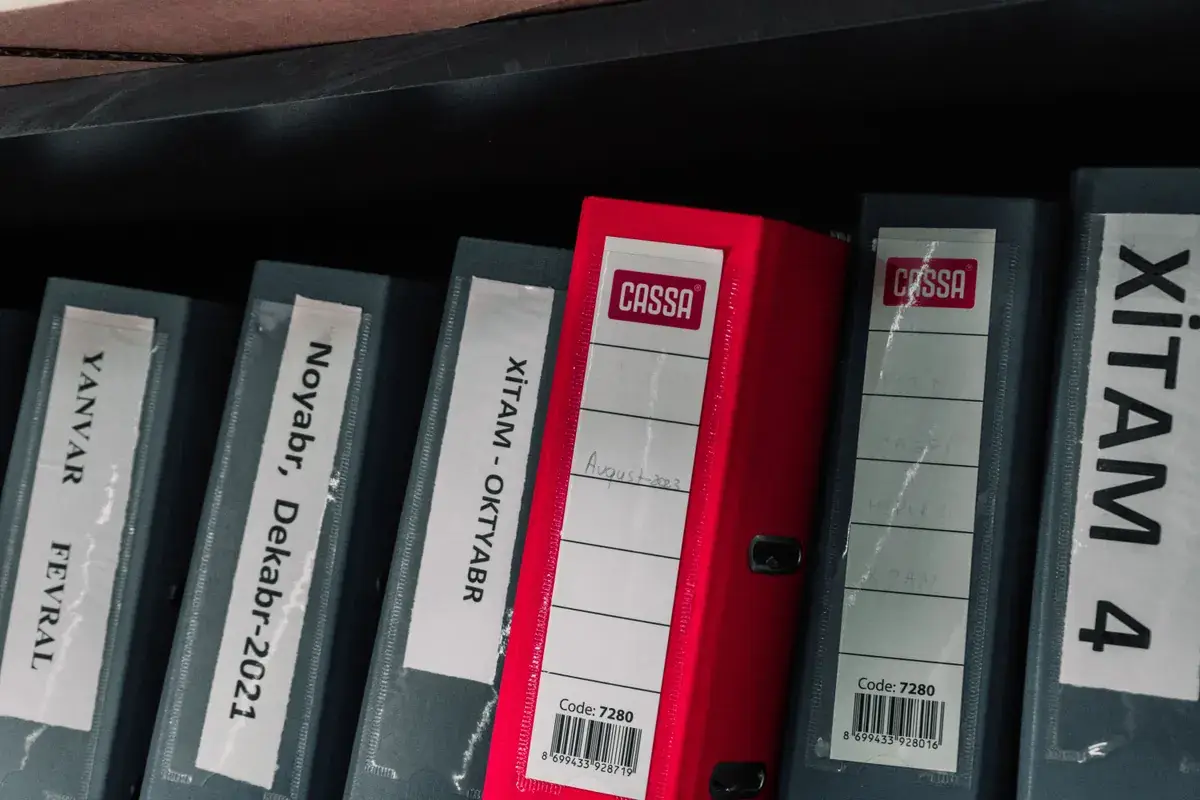
A home filing system you will actually keep up needs one in-tray, four folders, one archive box and a rule for how long each kind of paper stays. For most renters, two rules do nearly all the work. If you file a Self Assessment return, keep pay and tax records for at least 22 months after the end of the tax year (five years if you are self-employed). Keep everything about the tenancy, above all the deposit certificate, the inventory and dated photos, for as long as you live there and until the deposit is back in your account. Everything else gets photographed and shredded.
You don’t need a desk drawer for any of it. A wire in-tray on a bookshelf, four cardboard folders and one lidded box on top of the wardrobe are the entire system, which is roughly what a small flat has space for. In a shared house, each person keeps their own set. The tenancy folder is the only shared one, and a single copy is enough provided everyone knows whose room it lives in.
Why most filing systems die: too many categories
The usual first attempt gives every bill, account and year its own folder. That comes to something like eighteen folders, and eighteen folders means a decision about where each sheet of paper belongs. Those decisions are exactly what stop people filing. The post goes on the worktop “for now”, and a month later the system has been quietly abandoned.
Four folders leave you almost nothing to decide. Nearly all the paper that arrives is about the flat, your money, you, or something you own. A letter that fits none of those is probably one you can throw away.
The other thing that kills a system is that nothing ever leaves it. Paper with no retention rule builds up until the folder won’t shut. You need a cull, and a cull only happens if it has a fixed date. I’ve tied this one to the end of January.
The in-tray and the fifteen-second rule for post
Every piece of post goes into the in-tray, unopened, the moment you come in. Not the worktop, not the table, not the arm of the sofa. In a flatshare, one tray by the door with letters stood upright so the names show is far better than a heap on the stairs that nobody claims. This is the one rule you keep every day, and it fits into the evening walk-through of the 15-minute reset without adding a minute.
Once a week, at whatever time of day your brain is actually awake enough for it, open everything in the tray and give each item fifteen seconds. There are four things you can do with it:
- Bin it (marketing, envelopes, anything you could get again online).
- Deal with it straight away if it takes under two minutes (pay the bill, book the appointment).
- File it in one of the four folders.
- Photograph it, then bin or shred it.
Anything that needs longer than two minutes goes back in the tray with a note stuck to it. At any point the tray should hold that week’s post and a couple of those notes. Nothing more.
Four folders and what goes in each
Each folder is a plain cardboard document wallet with its name written on in marker pen. A label maker is not required.
Home and tenancy. The tenancy agreement, the deposit protection certificate, the inventory and check-in report, the gas safety certificate, the electrical report if the landlord handed one over, the energy performance certificate, and printouts of any emails to the landlord about repairs. Council tax and utility account letters belong here as well.
Money and tax. Payslips, P60s, the P45 from your last job, any Self Assessment paperwork, pension statements, bank letters that aren’t statements (statements stay online), and anything at all from HMRC.
Health and ID. The passport when you’re not travelling, NHS letters, repeat prescriptions, the driving licence paperwork and your birth certificate. It stays thin on purpose, because it’s the folder you grab first if there’s a fire.
Things I own. Receipts for anything over about £50, guarantees, warranty cards, and the manuals you might need one day (the boiler, the oven). If a manual can be downloaded, leave it as a download.
That’s the whole list. Add a folder for the car if you have one, and one per child if you have children. Couples living together do best with one shared Home and tenancy folder and a separate Money and tax folder each, which keeps the tax rules simple. What I would not do is start a folder per account.
How long to keep tax and pay records
This is the rule people are least sure of, and I had no idea myself until I read the source. If you send a Self Assessment return but aren’t self-employed, HMRC’s guidance says you should keep your records for at least 22 months after the end of the tax year the tax return is for. Its worked example: send your 2024 to 2025 tax return online by 31 January 2026, and you keep the records until at least the end of January 2027. File late and the rule becomes at least 15 months after you sent the tax return.
For the self-employed the period is much longer. HMRC says you must keep your records for at least 5 years after the 31 January submission deadline of the relevant tax year. Its example is a 2022 to 2023 tax return sent online by 31 January 2024, where the records have to be kept until at least the end of January 2029.
Day to day, payslips and P60s for this tax year and last sit in the Money and tax folder. When a year’s return has gone in, clip that year’s papers together, put a note on the front with its “keep until” date, and move the bundle into the archive box. Someone who is employed never has more than two years of bundles in there. Someone self-employed has about six.
Tenancy paperwork: deposit certificate, inventory, dated photos and repair emails
Of the four, this is the folder most likely to be worth real money. Your landlord or letting agent must put your deposit in the scheme within 30 days of getting it, and you should receive a certificate or confirmation that names the scheme. When you move out, the landlord has to return the deposit within 10 days of you both agreeing how much comes back. If you can’t agree, the scheme’s dispute service makes the call, and it makes it on evidence. In a shared house the deposit is normally one joint sum, so photos taken by everyone on move-in day protect the whole house, including whoever leaves first.
 Photo: Kaboompics.com via Pexels
Shelter’s list of evidence that wins a dispute is short and specific: the inventory and check-out report, dated photos, and emails showing, in Shelter’s words, repair problems during the tenancy and how quickly they were dealt with. On photos, Shelter says the schemes prefer digital ones, since the dates can be checked and the pictures tend to be clearer. I hadn’t expected that, and it means the tenancy folder is really half paper and half a folder on your phone. Back that phone folder up and name it after the flat’s address. Into it go the check-in photos, a photo of each repair problem, and screenshots of the emails where you reported it.
Say there’s a leak under the sink. The record it leaves is two dated photos of the damp patch, one email to the agent, one reply, and a photo of the cupboard after the repair. Under-sink storage that survives a leak deals with what to do on the day you spot it. Afterwards, the paperwork amounts to two sheets in the tenancy folder and a handful of photos on the phone.
Receipts and guarantees: photograph, then decide
Most receipts don’t need to be kept on paper at all. A photo in a phone folder called Receipts is usually enough for a return or a guarantee claim, and thermal till receipts fade to blank sooner or later regardless. So the rule is photograph first, decide second.
Hold on to the paper only when the item cost more than roughly £50 and is still under guarantee, or when the receipt is your only proof of a repair or a service (a boiler service, a bike service). Those go in the Things I own folder with the guarantee stapled to them. When the guarantee expires, out they go at the next cull.
The January cull
Once a year, on the weekend after the 31 January Self Assessment deadline, tip all four folders out onto the table and go through them against the retention rules above. It takes about forty minutes. Anything past its “keep until” date gets shredded if it shows an account number or address, and recycled if it doesn’t. Anything from the past year that you no longer use day to day but that is still inside a retention period goes into the archive box with its keep-until date written on it.
I chose January because the tax rule counts from 31 January, which keeps the arithmetic easy. In January 2027, anyone employed can let the 2024 to 2025 records go, and a sticky note on the box lid can remind you.
The archive box gets checked once a year and opened perhaps twice. For paper that only matters when something goes wrong, that seems to me about the right amount of attention. The other systems that feed into this one are in the organisation section.